<?xml version="1.0" encoding="utf-8"?>
<feed xmlns="http://www.w3.org/2005/Atom" xml:lang="en">

    <title type="text">Culture_arts</title>
    <subtitle type="text">Culture_arts:</subtitle>
    <link rel="alternate" type="text/html" href="http://www.dharmacafe.com/culture-arts/" />
    <link rel="self" type="application/atom+xml" href="https://dharmacafe.com/culture-arts/atom/" />
    <updated>2014-10-04T20:31:00Z</updated>
    <rights>Copyright (c) 2010, Bill Stranger</rights>
    <generator uri="http://www.pmachine.com/" version="1.6.9">ExpressionEngine</generator>
    <id>tag:dharmacafe.com,2010:01:07</id>


    <entry>
      <title>On a Throne Made of Vanishing Ink</title>
      <link rel="alternate" type="text/html" href="https://dharmacafe.com/culture-arts/on-a-throne-made-of-vanishing-ink/" />
      <id>tag:dharmacafe.com,2010:culture-arts/11.20</id>
      <published>2010-01-07T15:36:23Z</published>
      <updated>2013-04-24T21:17:24Z</updated>
      <author>
            <name>Bill Stranger</name>
            <email>comments@christinesuzuki.com</email>
                  </author>

      <content type="html"><![CDATA[
        <p><img src="http://www.dharmacafe.com/images/uploads/Allen_Ginsberg_thumb.jpg" border="0" alt="image" name="image" width="160" height="215" /> <b>His iconic poetry stamped the beat generation and helped open the door to the psychedelic sixties. This immortal paen to beauty suggests that the late, great bard may have been even better at prose.</b>
</p> <p>Makes very little difference what happens, the next ten years, because the main thing in the universe isn&#8217;t at all affected by these little shifts of anthills, musics, nations, marriages. The main thing&#8217;s nameless, so I&#8217;ll call it beauty&#8212;the King and Lord of the Cosmos, a perfect being who sits on a throne made of vanishing ink. It has a face so radiant that once you&#8217;ve seen it, or guessed at it, you know that this creature has always been here and will be around as long as it wants, and won&#8217;t be touched by men&#8217;s atomic claws or the scary dust of the Apocalypse.</p>

<p>Beauty is so perfect that it doesn&#8217;t depend on anything happening in this world that we see with our feet and brains. We&#8217;ve all seen beauty face to face, one time or other-and said &#8220;oh, my god, of course, so that&#8217;s what it&#8217;s all about, no wonder I was born and had all those secret weird feelings!&#8221; Maybe it was a moment of instantaneous perfect stillness in some cowpatch in the Catskills when the trees suddenly came alive like a Van Gogh painting or a Wordsworth poem. Or a minute listening to, say, Wagner on the phonograph when the music sounded as if it was getting nightmarishly sexy and alive awful, like an elephant calling far away in the moonlight.</p>

<p>At that moment you either kill your soul and go out and make money, or you pick up on the fact for good that there&#8217;s something ALIVE behind the universe that nobody, but nobody, has ever had the guts to meet. Or said much about it if they did, except in strange art or mathematic forms. Meeting the invisible elephant and looking in his eye means the end of you, and the eternal return of the old God that everyone at once knows and that never dies.</p>

<p>Beauty is beauty, that&#8217;s all there is to it. If you are interested in you, then you&#8217;re stuck with you and you&#8217;re stuck with your death. But if you get interested in beauty, then you&#8217;ve latched on to something mysterious inside your soul that grows and grows like a secret insane thought, and takes over completely when you die, and you&#8217;re IT.</p>

<p>A shuddery situation&#8212;it&#8217;s hard to let go your selfhood and have a good time with beauty&#8212;we&#8217;re brought up to scheme and battle to make it here and now with gold, lovers, power, clothes, and face that anyone from our mother to the next door neighbor cop can see and respect. But in the long run we&#8217;re all going to have to give up and drop dead and enter beauty&#8212;in fact beauty is what kills us, beauty is the great murderer. Get used to it early and it&#8217;ll save us all from a life of phony nightmare.</p>

<p>Life is a nightmare for most people, who want something else, not what life offers freely. People want a lesser fake of beauty, something transient and faulty, a hot-dog that&#8217;s doomed to disappear in the blink of an eye&#8212;any old grandmother will tell you.</p>

<p>This is a lot of nutty raving, but it needs to be said, if people want to hassle about the fate of the next 10 years. What&#8217;ll happen is that we&#8217;ll all grow older, get nearer to death, bear children, write poems, buy cars, see Paris or Moscow, mow the lawn, goof under trees in springtime.</p>

<p>And some of us will realize that our fate is old age, sickness and death, as the oriental sages say.</p>

<p>Now it&#8217;s weird enough to be in this human form so temporarily, without huge gangs of people, whole societies, trying to pretend that their temporary bread and breasts are the be-all and end-all of the soul&#8217;s fate, and enforcing this ridiculous opinion with big rules of thought and conduct, bureaucracies to control the soul, FBI&#8217;s, television, wars, politics, boring religions.</p>

<p>So what&#8217;ll we do in the next ten years? Blow up the universe? Probably not. But let&#8217;s blow up America&#8212;a false America&#8217;s been getting in the way of realization of beauty&#8212;let&#8217;s all get high on the soul.</p>

<p>WRITTEN: Nov. 4, 1959</p>


      ]]></content>
    </entry>

    <entry>
      <title>&#8220;Tacit Glimpses&#8221;: A Review of Adi Da Samraj&#8217;s &#8220;Transcendental Realism&#8221; and &#8220;Aesthetic Ecstasy&#8221;</title>
      <link rel="alternate" type="text/html" href="https://dharmacafe.com/culture-arts/tacit-glimpses-a-review-of-adi-da-samrajs-transcendental-realism-and-aesthe/" />
      <id>tag:dharmacafe.com,2008:culture-arts/11.1292</id>
      <published>2008-05-12T21:00:59Z</published>
      <updated>2014-10-04T20:31:00Z</updated>
      <author>
            <name>Bill Stranger</name>
            <email>comments@christinesuzuki.com</email>
                  </author>

      <content type="html"><![CDATA[
         <p>May 12, 2008 | &#8220;The image,&#8221; writes Adi Da, describing the making of his own art, &#8220;is the response itself&#8212;ecstatic, beyond and prior to &#8216;point of view&#8217;, &#8216;object&#8217;, separateness, duality, reflection, and likeness.&#8221;&nbsp; It is rare that artists have the courage to stand for a pure view of art. Yet in his two recent collections of essays on aesthetics, &#8220;Transcendental Realism&#8221; and &#8220;Aesthetic Ecstasy&#8221;, Adi Da Samraj raises the flag for an authentic spiritual experience embodied in art by calling for a &#8220;true art&#8221; that yields an immediate, sensory experience of a world of energies that transcend human perspectives and attachments. For him, the apparent multiplicity of ordinary events and images can be transformed by the creative artist into an experience of aesthetic ecstasy and inherent unity. Both manifesto and meditation, these pieces are intended to not only open our perception to a more fully present experience of art, but to allow Adi-Da&#8217;s own image-art to effect this change. Weaving intention and actuality in his writing, Adi Da&#8217;s &#8220;Transcendental Realism&#8221; and &#8220;Aesthetic Ecstasy&#8221; are challenging and rewarding reading for artists and anyone interested in art as a transformative experience.</p>

<p>Although his own spiritual realization unfolded spontaneously, Adi Da also makes use of his profound learning in philosophy, psychology, art, and the esoteric, psycho-physical traditions of both Asian and Western cultures. And he is aiming to do nothing less than restore transcendental purpose to post-modern culture. The text image appearing on the cover of both volumes&#8212;a triangle within a circle within a square, inscribed with the daisy-chained aphorism &#8220;Reality Itself Is Truth Itself Is The Beautiful Itself Is&#8221;&#8212;is a clear attempt to replace &#8220;the Good, the True, and the Beautiful&#8221; as the founding triad of Western high culture, while also establishing the three aforementioned shapes as the &#8220;primary geometries&#8221; (each bearing a unique esoteric meaning) upon which all art is based. </p>
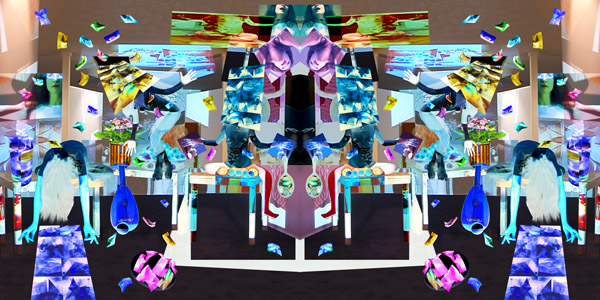
<p><img src="http://www.dharmacafe.com/images/uploads/236.Spectra.One_Entry_0126_LRG.jpg" alt="image" width="580" height="290" />
</p><font color=#FF0000><p align=center>Image: <b>The Pastimes of Narcissus II/92</b>, 2006 
(from <i>Spectra One</i>)
</p align=center></font color=#FF0000>

<p>Adi Da asserts that true art has one and only aim: moving the viewer toward an ego-dissolving mystical experience of wholeness, opening us to a visual epiphany&#8212;a sensual state of immediacy and pure enjoyment. He builds his own art in many ways: initially working for some years with multiple exposures of photographs that capture, &#8220;in camera&#8221;, a multiplicity of viewpoints, he now works almost entirely with purely digital constructions. Some recent works have combined his visual strategy of multiple perspectives with mandala-like central geometry, presented on a scale so large as to encompass the viewer. Using the modernist technique of scale developed in the paintings of the &#8216;70s and &#8216;80s, the works also incorporate saturated color and an isolation of the image in a darkened space, giving the images a sense of power. Adi Da intends the contradictions within the image to inspire a vivid state of awareness that transcends causal thinking. These visual images oscillate with contemplation, echoing modern poetry&#8217;s repetition of images and use of multiple voices, undermining, as Adi Da writes, a fixed perspective.</p>

<blockquote><p>My image-art can be characterized as paradoxical space that undermines &#8216;point of view&#8217;. That undermining (which occurs in any instant of fully felt participation in any of the images I make and show) allows for a tacit glimpse, or intuitive sense, of the Transcendental Condition of Reality . . . totally beyond and prior to &#8220;point of view&#8221;.
</p></blockquote>

<p>{pagebreak}</p>

<p>As a young man Adi Da studied Gertrude Stein, and, as much as I avoid the biographical view, he has distilled her essence in image-repetitions that ultimately dissolve any fixed notion of what we are seeing. A context for Adi Da&#8217;s visual aesthetic can also be found in Kazimir Malevich&#8217;s purity of geometric form, Kandinsky&#8217;s harmonic improvisations, and Picasso&#8217;s and Braque&#8217;s Cubist investigations of multidimensional space; similarly, these artists wrote compellingly about their visions. Artistically aligned with the basic strategies of modernism, in his writing Adi Da calls for a &#8220;new-old&#8221; kind of &#8220;Conscious Light&#8221;.</p>

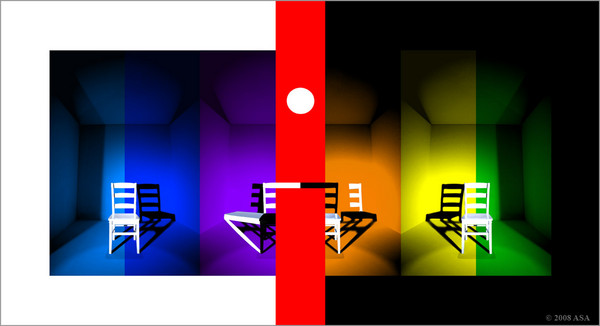
<p><img src="http://www.dharmacafe.com/images/uploads/Spectra_Ten.jpg" alt="image" width="600" height="326" />
</p><p><font color=#FF0000></p><p align=center>Image: <b>The &#8220;First Room&#8221; Trilogy I</b>, 2006 
(from <i>Spectra Ten</i>)
</p align=center></font color=#FF0000>

<p>Adi Da&#8217;s writings, though they arise from his own direct spiritual experience, seem nonetheless informed by Asian spirituality, Western Platonic notions of art, and echoes of cognitive, perceptive and psychological theory. Still, the writing is as much poetry as a meditation on the fundamental nature of art, and understanding it will depend on your ability to allow his words to encompass specific and multiple meanings. Adi Da&#8217;s aesthetic philosophy compresses language in a style that many will find demanding, but readers will find these essays well worth the effort.&nbsp; This compressed &#8216;morse code&#8217; becomes a leitmotif of the writings, recalling the meditations of the young Giorgio de Chirico, whose illuminated experiences provided the impulse for his enigmatic paintings. Indeed, while Adi Da&#8217;s aphorisms run parallel to the kind of thinking expressed by artists for whom perceptions appear intuitively, we also find in them reflections arising from an expansive inquiry into art and spiritual experience.&nbsp; Both publications include a glossary that introduces you to basic elements of the artist&#8217;s philosophy. Perhaps the best entry point comes with the essays collected in &#8220;Aesthetic Ecstasy&#8221;, a critique of the art world written in language more familiar to a general audience. </p>

<p>I found Adi Da&#8217;s rejection of the art market&#8217;s commodity a welcome criticism of the superficiality and abstruse discourse currently dominating the art scene. Ironically, in Canada, where I live, artists are workers in the &#8220;cultural industries&#8221;&#8212;an essentially socialist idea that nonetheless bases itself on economics, changing the role and perception of the artist from caf&#233;-society slouch to that of a &#8220;cultural worker&#8221;. Commodity, developed through the system of galleries, museums, art fairs, and granting systems, has become a kind of inescapable black hole for art. Taking apart the art world&#8217;s conventions, Adi Da argues convincingly for art to become instead the means for an authentic transformative experience. Living far from the centers of commerce, he has a detachment that allows an understanding of the system, and the spiritual conviction to make his ideas known. Artists who deeply feel the sensual and spiritual energy of creativity will undoubtedly embrace his view.</p>

<p>Adi Da&#8217;s incisive critique of contemporary art&#8217;s cleverness and superficiality lays bare a reality many recognize but are too intimidated to express. With his pointed description of the media-driven mindset employed by museums, Adi Da shows how these institutions have come to dictate how we should feel and what we should think about art. His wit cunningly uncovers issues many artists choose to ignore. While some curators object to these psychological controls, it is, as Adi Da points out, mainly in the art world where art becomes intellectualized. Tellingly, he compares this to the gut feeling and direct emotion that modern music still manages to evoke in contemporary audiences, leading us to wonder what forces the creative spirit into the cynical circuit of art world accounting.</p>

<p>Adi Da&#8217;s notion of &#8220;image-art&#8221;&#8212;the perceptual threshold where art merges surface and symbol&#8212;is liberating for artist and audience alike. Although evocative, images, like feelings, are unquantifiable. Freeing his &#8220;participant&#8221; to experience the poetry of images without conceptual definition, Adi Da rejects contemporary culture&#8217;s love of surface, its dependence on representational narrative. For Adi Da, art has the potential to illuminate consciousness&#8212;to give form to the &#8220;aesthetic ecstasy&#8221; of engagement. He writes,</p>

<blockquote><p>My image-art functions entirely in the context of perceptually based whole bodily (or total psycho-physical) participation. My image-art has no political purpose or function. My image-art does not, itself (or by intention), represent any system of academic comparisons and historical accounting. . .&nbsp; My image-art is the &#8220;subjective&#8220;space of participation for whoever participates in it.</p></blockquote>

<p>Adi Da proposes that the expression of feeling in form allows a boundary-less aesthetic&#8212;an unmediated engagement with the participant. It is an idea of image-art that will no doubt be welcomed by many artists who strive to make images but who feel caught in the tension between consumerism and materialism.</p>

<p>Adi Da&#8217;s art eschews the Western development of linear perspective, as well as the more recent use of formalism, that turns the aesthetic experience itself into an art object. In his art, the world is a mutable place where no single viewpoint dominates. Both representational and formal streams have merit when handled by illuminated artists&#8212;from Vermeer to Rothko or Wang Wei&#8212;but, according to Adi Da, even representational art is too conventional to effect transformation. Moreover, our obsession with stylistic categories, he says, obstructs direct experience of art. True art, on the other hand, leads inevitably to &#8220;aesthetic ecstasy&#8221;. Adi Da&#8217;s challenging of conventional ideas can make for some dense reading, but its cumulative effect has force.</p>

<p>{pagebreak}</p>

<p>Expressions of intentionality have become increasingly common in the art world, but they are rarely made by those as thoughtful as Adi Da. His broad argument for transcendental realism over against the limitations of art history is strong stuff. While visual art does not always express the artist&#8217;s intention, good art should always do so, and it should do it forcefully. This divide separates the high-minded vogue for the artist&#8217;s statement from works that actually realize the artist&#8217;s vision. </p>

<p>In a literary sense, some may find the challenge of &#8220;Transcendental Realism&#8221; a large, rather rhetorically weighty argument for his work to sustain. It would certainly be interesting for other artists to engage with him in a dialogue, one that explores the essential vitality that is the peculiar domain of the true artist. Seeing Adi Da&#8217;s works themselves (catalog reproductions fail to do them justice) allows you an experience of the artist&#8217;s intention to create an experiential and transcendent image-art.</p>

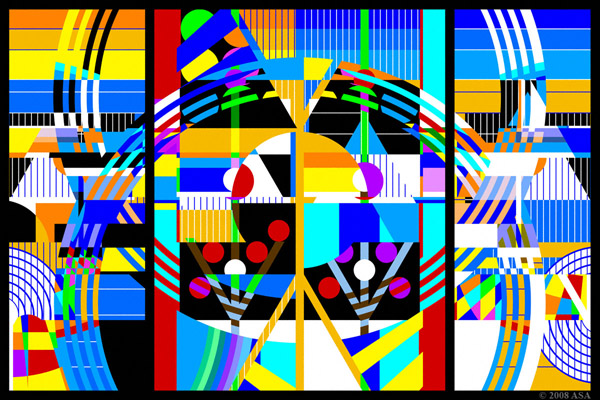
<p><img src="http://www.dharmacafe.com/images/uploads/Albertis_Window_-_Center_Panel600.jpg" alt="image" width="600" height="400" />
</p><p><font color=#FF0000></p><p align=center>Image: <b>Alberti&#8217;s Window I</b> (detail), 2006&#8211;2007
(from <i>Geome One</i>)
</p align=center></font color=#FF0000>

<p>Adi Da&#8217;s image Spectra One I/1 (pictured in Transcendental Realism) brings up many themes&#8212;light, no &#8220;point of view&#8221;, centrality, and geometry; each are elements of his call for a new kind of art, and central to the aims of his own work. The suite Geome One: Alberti&#8217;s Window, illustrated in Transcendental Realism, contrasts Adi Da&#8217;s image-art with Renaissance illusionism. Viewing the piece, one becomes engaged with a geometric, discontinuous space that becomes a full contradiction of the fixed frame of reference&#8212;Alberti&#8217;s window&#8212;that forms the basis for much of Western art history. While this series is the most non-objective of his works, the Spectra Suites nonetheless employ elements of the visible world to create a realm of paradox. Visual art, like music, forms a harmonic structure through multiple shifting, ambiguous states of mind and layers of psychological and spatial perspectives. Adi Da often uses prismatic repetition&#8212;perhaps absorbed from his interest in modernism&#8212;creating a fluctuating perspective of multidimensional space. His intense use of color is brought to life through digital processes that allow for large-scale production of invented geometrics and ambiguous spaces:</p>

<p> </p><blockquote><p>My process of creating images brings together two principal elements, in a complex approach. One is the comprehensive element of form, and the other is the element of fundamental content (or essential meaning). On the one hand, I constantly exercise the formal element, and, thus and so (and by means of an always spontaneously free process of improvisation), I strictly control and order the structure of the images I invent. On the other hand, I am, likewise constantly, intent upon maintaining and profoundly enlarging the characteristic of meaning. Indeed, the meaning-content is always primary.</p></blockquote>

<p>Many artists have been stymied by the intellectual and economic machinery of the art world. It is an environment that negates the lyrical, the voice of the mystic, the sensuality that expresses the fragility of existence. In arguing for authenticity in art, Adi Da argues for those artists that cannot give voice to these feelings, either because they are hamstrung by the economics of the gallery system, or because they are stymied when faced with the smoke-screen rationales of the social and commercial sub-industries that feed off the artist. In this &#8220;fearful new world&#8221;, only the calculating and the lucky survive.</p>

<p>	Most artists feel their work is something alive and irreducible, and they naturally want to protect it from classification. Images embody the spiritual expression of an artist&#8217;s work because their qualities cannot be reduced to formal analysis. Exploring this notion, Adi Da writes,</p>

<blockquote><p> I am calling for a right and true use of the image-art I make and do&#8212;a use to which even all art should be put&#8212;in which the viewer is simply face to face with the art, without anything or anyone in-between, and with no extra-artistic uses whatsoever. Any true moment of participation in a work of art is&#8212;in the most positive sense of the word&#8212;&#8216;use-less&#8217;. . . there is only the moment in which the viewer fully participates.</p></blockquote>

<p>Such intentions can never be fully explained by historical influences or deconstructive tropes. They are the marks of an authenticity that, more than ever, the world is longing for. </p>

<p>Adi Da extends and expands an alternative understanding of art that has run like an underground stream through history: appearing intermittently in the meditations of the scholar-artists of China&#8217;s T&#8217;ang dynasty; in the writings of Leonardo and Michelangelo in the Renaissance; and in the aesthetic theories of Kandinsky and Mondrian in the modern era. Taken together, the writings of these artists reveal a long-neglected tradition of insight, one that has been rejected in our culture&#8217;s dismissal of anything that cannot be positively proven. These artists&#8217; insights&#8212;however marginalized they have become in the history of knowledge&#8212;require a language capable of expressing the intrinsic qualities of art.</p>

<p>{pagebreak}</p>

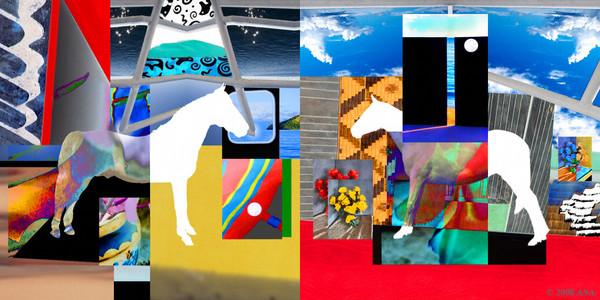
<p><img src="http://www.dharmacafe.com/images/uploads/SpectraTwo_thumb.jpg" alt="image" width="600" height="300" />
</p><p><font color=#FF0000></p><p align=center>Image: <b>A Horse Appears In The Wild Is Always Already The Case, IV/1</b>, 2006 (from <i>Spectra Two</i>)</p align=center></font color=#FF0000>

<p>As art history formed in the nineteenth century, it took its modes of classification from archaeology, botany, and zoology. Thus formed, art history was never purposed to convey an experiential state of mind, even though such experiences were embedded in the artist&#8217;s touch. These illuminated writings did appear, but not in the realms of formalist Western art history. Instead, they were found, from the Renaissance forward, in poetry, music, in biography and art theory, in the disciplines of anthropology, history of religions, psychology,&#8212;all forms that explored human experience. Suzanne Langer, Titus Burckhardt, Mircea Eliade, James Hillman, and others investigated the experiential transformation of feeling into form, and essence into image. The modern artists&#8217; manifesto became a call to arms for disrupting the conventional view of art. </p>

<p>This breaking with convention is precisely the aim of Adi Da&#8217;s book. Alongside his philosophical stance, he outlines the spiritual intention of his art, staking out new ground in this important alternative body of knowledge. Not only rejecting historicist notions of progress in art, Adi Da also transcends mere critique to assert the power of art to transform the viewer&#8217;s actual experiential state.</p>

<p>The root of this transcendent art, Adi Da writes, is the radiance of a world penetrated and informed by a divine light: </p>

<blockquote><p> I have no impulse to make and do art on the basis of &#8216;post-modern&#8217; (or even &#8216;post-civilization&#8217;) cultural breakdown. This is why I worked so intensively to re-establish a basis for Reality-culture, a Truth-culture&#8212;before I could intensively make and do art within the context of an actual and living culture of Reality and Truth.</p></blockquote>

<p>Before we can participate in truth and the beautiful as aesthetic experience, Adi Da says, our emerging world culture needs to be transformed by the possibilities of sacred energy, the Light that runs through all things. It is a mystical view that runs through both Western and Eastern cultures, from the biblical call to &#8220;see with new eyes&#8221;, to St. Francis Assisi&#8217;s understanding of the natural world as expressing divine presence, to the Chinese scholar-artists&#8217; perception of the formlessness in form, to the transformative spaces of Monet or Rothko. This intuitive stance provides hope for romantic and mystical artists, hope that the essence of their work will become manifest. </p>

<p>That Adi Da challenges our culture to return art to its original, sacred purpose without merely recreating a long lost past makes &#8220;Transcendental Realism&#8221; a significant work, not only for artists but anyone who senses the limitations of contemporary culture and strives to create a more vivid way of being.</p>

<p><i>Celia Rabinovitch is an artist, writer, and teacher. Her paintings have been exhibited in solo shows in Canada, the U.S.A. and Europe, including Quattro, a four person international show in Vienna, Austria (2000), the Florence Biennale (1999) The Grotto Cycle, California Institute of Integral Studies (2003); Industrial Romance, University of San Francisco and </p><p><SITE></p><p> Gallery, Winnipeg, YYZ, Toronto; Emily Carr Institute; Plug-In and the Winnipeg Art Gallery. Her book, &#8220;Surrealism and the Sacred: Power, Eros, and the Occult in Modern Art&#8221;, 2002 uncovers new territory between the history of art and the history of religions. Celia Rabinovitch has taught art and cultural and art history at Stanford University, U. C. Berkeley, The California College of Art and the San Francisco Art Institute, the University of Colorado, McGill University and as a Visiting Artist at Syracuse University (1990). Born in Morden, Manitoba, she studied at the School of Art, University of Manitoba (B.F.A., B.A,) the University of Wisconsin (MFA painting) and McGill University, Montreal (Ph.D. history of art and religions). Currently she is Professor and Director of the School of Art, the University of Manitoba.</i></p>


<p>&nbsp;</p>

<p>&nbsp;</p>
      ]]></content>
    </entry>

    <entry>
      <title>Postmortem on Postmodern Art</title>
      <link rel="alternate" type="text/html" href="https://dharmacafe.com/culture-arts/postmortem-on-postmodern-art/" />
      <id>tag:dharmacafe.com,2007:culture-arts/11.125</id>
      <published>2007-04-24T02:37:00Z</published>
      <updated>2007-08-25T01:16:44Z</updated>
      <author>
            <name>Bill Stranger</name>
            <email>comments@christinesuzuki.com</email>
                  </author>

      <content type="html"><![CDATA[
         <p>Remember that queer psychic malaise that kept nagging at you while you were sipping a glass of wine at that high-end art opening your friends dragged you to last  month? How something in your soul couldn&#8217;t shake the feeling of vanity and emptiness that kept insinuating itself as you strolled among the unsatisfying pictures?</p>

<p>Are you still trying to find your way clear of the dense fog of soul negation and outright chicanery being offered up&#8212;or is it down?&#8212;by what still, despite all evidence to the contrary, lays claim to the appellation &#8220;The Art World?&#8221;</p>

<p>Take heart, my friend. You may be surprised to learn that it&#8217;s probably not necessary to consult your therapist&#8230;or your astrologer&#8230;or to up your dose of whatever pharmacological miracle you&#8217;re currently using these days to ward off The Demons.</p>

<p>Indeed, your reaction to much of what currently lays claim to the exalted status of &#8220;postmodern art&#8221; may be ironic proof of your insistent sanity. You are surely not alone. In fact you are in very, very good company.</p>

<p>Donald Kuspit&#8217;s withering critique of postmodern art is an inspired defense of the great aesthetic formally known as high art, as well as a surgical exposure of the mocking,<br />
entropic cynicism which has ravaged this creative ethic for decades. His courageous book, The End of Art, makes the claim that ominous forces have overwhelmed the ancient understanding that art is purposed to serve our understanding of the transcendental.</p>

<p>Despite the ever-changing array of ephemeral art-theories and fashionable schools of strictly surface concern, Kuspit remorselessly outlines how what he describes as &#8220;postart&#8221; has purposely obliterated that unique gift which can relieve us of the agony of a stark materialism, and which alone enables us, mercifully, to exist with integrity in what is clearly a madhouse world. Kuspit begins where he sees the genesis of this relentless and willful obfuscation: with the famous readymades of Marcell Duchamp and the primal, pre-Adamic existentialism of Barnett Newman.</p>

<p>It was Duchamp who deliberately projected a sort of baffling double-mindedness onto his notoriously ordinary objects; who attempted to seduce the observer into the fantasy notion that his works of art were all and nothing at once&#8212;a simultaneous degradation-exaltation radiating from an elusive center which would vanish the instant it was conceptually apprehended.</p>

<blockquote><p>Can one see such objects both ways&#8212;as everyday artifacts and elegant works of art simultaneously? That is exactly how Duchamp would like us to see his readymades. They have a double identity. They are socially functional artifacts that have been changed into sublime artistic masterpieces by the creative act of Duchamps&#8217; psyche. But they retain their everyday functionality; they revert to it in the blink of a creative eye, or rather in the mind. In short, they embody aesthetic osmosis while remaining inert matter. Supremely ambiguous, they are supremely perverse; that is, they blur the difference between art and non-art, an act of differentiation all too often regarded as the gist of modern creativity. The tantalizing ambiguity that is the readymade precludes aesthetic idealization. When The Fountain, (1917) was praised as beautiful and tasteful, as occurred when it entered the  museum, Duchamp became angry, for it was understood exclusively on the aesthetic plane, which destroyed its confused identity as art/non-art, that is, mentally art, physically non-art.
</p></blockquote>

<p>It was Duchamp&#8217;s attempt to dismiss the aesthetic responsibilities of the artist be feigning a sort of sublime indifference to it&#8212;by leeching it of emotion&#8212;and by therefore suggesting that a crippling ambiguity is the actual source-condition of existence; that indeed a kind of elemental confusion is the native and eternal condition of mankind. Duchamp intended to strike at the very heart of art itself, by denigrating aesthetics as a farcical absurdity. It is Duchamps&#8217;s insistence on a primal ambiguity that exposes his loveless nihilism&#8212;he retreated to the rigors of chess after relegating art to a sort of secondary concern&#8212;as well as his need to lay waste to the totality of culture which had come before him. Indeed Duchamp&#8217;s methods seem to embody what Blake decried as &#8220; a pretence of Art to destroy Art&#8221; which has, not surprisingly, devolved over the decades into what Kuspit now dismisses as anti-art, or postart, or mere commercial entertainment and creative degradation.&nbsp;  &nbsp;  &nbsp;  &nbsp;  &nbsp;  &nbsp;  &nbsp;  &nbsp;  &nbsp;  &nbsp;  &nbsp;  &nbsp;  &nbsp;  &nbsp;  &nbsp;  &nbsp;  &nbsp;  &nbsp;  &nbsp;  &nbsp;  &nbsp;  &nbsp;  &nbsp;  &nbsp;  &nbsp;  &nbsp;  &nbsp;  &nbsp;  &nbsp;  &nbsp;  &nbsp;  &nbsp;  &nbsp;  &nbsp;  &nbsp;  &nbsp; <br />
{pagebreak}<br />
In the case of Barnett Newman, Kuspit finds the aesthetical under siege in the anti-human insistence of Newman on certain primitive, almost animistic energies which he felt were the essence of all created phenomenon. For Newman, art involved a sort of return to a state before the fall of biblical man, before civilization and its accelerating madness. He experienced himself as defiantly alone in a profoundly inhospitable universe. He believed in a regression to some pre-human state of being which was essential to his notion of creativity, to his dependence on a kind of preternatural energy which could elevate him above the bleak mediocrity of industrial society. His was a sort of abstract paganism, in which only a mythic return to pre-human creative energies could justify the lonely howl of the artist, acutely separate and adrift in a universe of eternal night.
</p><blockquote><p> What Newman calls the &#8220;primal aesthetic root&#8221; is inseparable from &#8220;original man, shouting his consonants&#8230;in yells of awe and anger at his tragic state, at his own self-awareness and at his helplessness before the void&#8230;It was a primal act, full of the futility of self-recognition, acknowledging human isolation in an inhuman universe.</p></blockquote>

<p>It is the unique gift of Kuspit to see behind these clever masks of mental seclusion; and to follow the devastating trends in art which have brought us at last to the point where we can no longer assert that art has any real import in our lives at all. What both Duchamp and Newman held in common was the bedrock notion that the aesthetic of art be confined to a strictly mental function; that indeed the separate, personal mind of the artist is the seminal truth in art, and that the actual process of making a work of art and the end-product itself are inferior to its isolated conception. That is to say, they each represent two different modes of a willful retreat into the personal labyrinth of human subjectivity, into a kind of gloomy mental isolation. Thus Newman and Duchamp exemplify what occurs when the dynamic energy of life and love are deliberately withdrawn from the actual human world of culture and art, when what Freud called the &#8220;death instinct&#8221; lays claim to our most passionate relational aspirations.&nbsp;   </p>

<p>Kuspit brilliantly traces the downward-spiraling trends of this malevolent assault on aesthetics in art; and we arrive at last at the melancholy present, where commerce and the surface diversions of mere entertainment have almost entirely subsumed what was once known as fine art, or high art. The inspired art that can move us deeply, that can re-connect us with the healing realms of the great unconscious, can find no path into the shrill markets of postmodernism, where the exaltation of the vulgar, the banal, the commercially viable and the strictly ideological are the price of entry.</p>

<p>Andy Warhol most negatively embodies Kuspit&#8217;s most passionate concerns. With Andy Warhol we reach the final entropic hell of art in the western world. Warhol&#8217;s genius, if such it could be called, was in his cynical manipulation of the market mechanism in the artistic realm. He saw how the market, with its inhuman dynamic, could be used to exploit art in a mass culture driven by commercial advertising. It is with Warhol that the vivifying energy so critical to human culture is handed over to a passive, assembly-line mechanics, a pervasive dullness which can only appeal to the latent morbidity of the human ego. It is with Warhol&#8217;s cynical celebration of profit over inspiration that postmodern art becomes what Blake called &#8220;the mere art of guinea-mongering.&#8221;</p>

<blockquote><p>By identifying art with money, Warhol devalues art while giving it the value of money&#8212;which is valueless unless it can be exchanged for something. Art loses spiritual cachet to gain social and economic cachet&#8212;the credibility, influence, and power that only money has in a consumer society. The artist was once thought of as sacred&#8212;he had a spark of God&#8217;s creativity in him&#8212;but Warhol&#8217;s artist is a businessman, profaning everything sacred and creative by putting a price on it, as Marx said. Warhol is a born salesman; with him art loses its mystery and openly becomes a commodity for sale. It seems to have no other identity than that of a commodity and no other value than the economic value it acquires by being sold. It also has the built-in obsolescence of every commodity. It inevitably loses excitement with time&#8212;after the fifteen minutes in which it was famous, and thus exciting, as Warhol said. Warhol&#8217;s art exploits the aura of glamour that surrounds material and social success, ignoring its existential cost. His art lacks existential depth; it is a social symptom with no existential resonance. He began his career as a commercial artist, and never stopped being one, ultimately making upscale commercial art&#8212;a deadpan art about commercial celebrities, including himself. He assimilated art into money, robbing it of spirituality and integrity. For Warhol, art is not a private religion that promises salvation, but a branch office of the religion of money. Warhol, like Duchamp, who was also obsessed with money, and also made deadpan art, is what the law calls a &#8220;corrupt persuader&#8221;, not to say panderer, toying with desire the way Duchamp played with intellect.
</p></blockquote>

<p>It is not so much that Kuspit is pointing out that the emperor has no clothes; rather it is that he understands that the emperor is a corpse; and that we are all of us participants in a collective pathology, a bizarre postart cult which is an ironic and exhausted consecration of death.<br />
{pagebreak}<br />
Yet even as our world careens toward some grotesquely-willed apocalypse, Kuspit announces the resurrection of the aesthetical ideal with the arrival of what he calls the New Old Masters. These are emerging artists who, while honoring both the traditional and the avante-gard, are creating works of art which regenerate the great spirit of the past with a visionary penetration of contemporary life. They are returning art to its natively unified dynamic&#8212;they insist that the concept be alive in the creation; that there is no enduring hierarchy between the mind of the artist, the process of creation, and the final, material work of art itself. Hence the elusive barriers which have so bitterly isolated the public from any genuine sense of a unifying aesthetic are being dissolved; and we are reminded, yet again, that in the ancient cultures the word artist was best translated as &#8220;worker for the people.&#8221;</p>

<p>Donald Kuspit has reminded us that when art and science become corrupted, there remain no effective means for civilization to honor all that which is great in God and man. He has with  mpeccable integrity shown us the price we all of us must pay when these noble arms of humanity become withered, become preoccupied with a mocking triviality; a fascination with greed, fame, and a fearful immunity from the simple human fate of living-and-dying.</p>

<p>&nbsp;</p>

<p><br />
Wayne Owens is a writer who lives in a spiritual community in Northern California.<br />
&nbsp; </p>

<p>&nbsp;</p>
      ]]></content>
    </entry>


</feed>