<?xml version="1.0" encoding="utf-8"?>
<feed xmlns="http://www.w3.org/2005/Atom" xml:lang="en">

    <title type="text">Gaia non Humans</title>
    <subtitle type="text">Gaia non Humans:</subtitle>
    <link rel="alternate" type="text/html" href="http://www.dharmacafe.com/gaia/" />
    <link rel="self" type="application/atom+xml" href="https://dharmacafe.com/gaia/atom/" />
    <updated>2023-10-23T00:10:55Z</updated>
    <rights>Copyright (c) 2009, Bill Stranger</rights>
    <generator uri="http://www.pmachine.com/" version="1.6.9">ExpressionEngine</generator>
    <id>tag:dharmacafe.com,2009:12:25</id>


    <entry>
      <title>How to Befriend a Tree</title>
      <link rel="alternate" type="text/html" href="https://dharmacafe.com/gaia/how-to-befriend-a-tree/" />
      <id>tag:dharmacafe.com,2009:gaia/19.377</id>
      <published>2009-12-25T20:37:54Z</published>
      <updated>2023-10-23T00:10:55Z</updated>
      <author>
            <name>Bill Stranger</name>
            <email>comments@christinesuzuki.com</email>
                  </author>

      <content type="html"><![CDATA[
         <p><i>&#8220;Chi Nei Tsang: Internal Organs Chi Massage&#8221;, Mantak and Mannewan Chia&#8217;s manual for practitioners of traditional Chinese medical massage, is yet another fine fruit of Chinese Taoist cosmology. Mao retained Traditiional Chinese medicine while otherwise industrializing his country, which allowed China to continue its multi-millenia tradition of developing this great clinical science unencumbered by Communist dogma (while also spreading it throughout the Western world). That a large percentage of potential in-patient visitors to Chinese hospitals are almost immediately discharged on the basis of a chi massage argues for what a serious and effective medical methodology it is. How playful and profound the artful science of Chinese internal organ massage actually is can be at least partially appreciated through the exercises presented below.</i></p>

<p><b>COLLECTING TREE ENERGY<br />
</b> <br />
<b>1. The Healing Abilities of Trees</b><br />
	Taoist Masters observed that trees are tremendously powerful plants. Not only can they absorb carbon dioxide and transform it into oxygen, but they can also absorb negative forces and transform them into good energy. Trees strongly root with the Earth, and the more rooted the tree, the higher it can extend to Heaven. Trees stand very still, absorbing the Earth&#8217;s Energy and the Universal Force from the Heavens.</p>

<p>	Trees and all plants have the ability to absorb the light of the energies and transform it into food; in fact, they depend on light for most of their nourishment, while water and earth minerals make up about 30% of their nutritional intake. Trees are able to live very long lives.</p>

<p><b>a.	The Tree as Healer and Friend</b><br />
	Trees are the largest and most spiritually advanced plants on earth. They are constantly in meditation, and subtle energy is their natural language. As your understanding of this language grows, you can begin to develop a relationship with them. They can help you open your energy channels and cultivate calm, presence, and vitality. You can reciprocate by helping them with their own blockages and devitalized areas. It is a mutually beneficial relationship that needs cultivation.</p>

<p><b>b.	Choosing a Tree to Work With<br />
</b>	Throughout history human beings have used all parts of the tree for healing and medicine. The best trees for healing are big trees, especially pines. Pine trees radiate Chi, nourish blood, strengthen nervous systems, and contribute to long lives. They also nurture souls and spirits. Pines are the &#8220;Immortal Tree.&#8221; Early Chinese poetry and painting is full of admiration for pines.</p>

<p>	Although pine trees are often the best choice, many other trees or plants can be used. The larger trees contain the most energy. Among the most powerful are trees growing near running water. Some trees feel warmer or hotter than others; some feel cooler or colder than others. Practice distinguishing the varying properties of different trees.</p>

<p>1.&nbsp; Cypress and cedar trees reduce heat and nourish Yin energy.<br />
2.&nbsp; Willow trees help to expel sick winds, rid the body of excess dampness, reduce high blood pressure, and strengthen the urinary tract and bladder.<br />
3.&nbsp; Elm trees calm the mind and strengthen the stomach.<br />
4.&nbsp; Maple trees chase sick winds and help reduce pain.<br />
5.&nbsp; Locust trees help clear internal heat and help balance the weather of the heart.<br />
6.&nbsp; Banyan trees clear the heart and help to rid the body of dampness<br />
7.&nbsp; Cinnamon trees can clear coldness from the heart and abdomen.<br />
8.&nbsp; Fir trees help clear up bruises, reduce swelling, and heal broken bones faster.<br />
9.&nbsp; Hawthorn trees help aid digestion, strengthen the intestines, and lower blood pressure,<br />
10.&nbsp; Birch trees help clear heat and dampness from the body am: help to detoxify it.<br />
11.&nbsp; Plum trees nourish the spleen, stomach, and pancreas and calm the mind.<br />
12.&nbsp; Fig trees clear excess heat from the body, increase saliva. nourish the spleen. and help stop diarrhea.<br />
13.&nbsp; Ginco trees help strengthen the bladder and alleviate urinary problems in women. </p>

<p>You do not need to go far out into the forest to find an appropriate tree to work with. Trees that are used to having people around understand our energy and are actually more accessible and friendly than those far out in the wilderness. City parks and suburban yards are filled with powerful and accessible trees that would love to have closer relationships with the humans that dominate their environment.</p>

<p>There is a certain size range within which trees are most accessible to human beings. When a tree is too small, it does not have enough energy to make much of an impression on you. When the tree is too big, you have the opposite problem, so it takes more persistence to get large trees to take an interest in you. As a source of healing energy, it is best to choose a large, robust tree from within the accessible size range. For playful interaction it is best to choose a small to medium sized tree. While it is not necessary to climb the tree to develop a relationship, it does open up a whole new world, Climb gently and carefully so as not to harm the tree. <br />
 {pagebreak}<br />
<b>c. Establishing Communion with a Tree<br />
</b>There are certain methods to approaching, interacting with, retreating from and taking leave of a tree. By following specific steps you create a ritual of silent communion that both you and the tree can understand, and so increase the potential for harmonious interaction. The steps were derived from observation of the natural course of events in subtle energy communion, and apply to communion with just about anything: tree, rock, human, or animal, although the following is concerned specifically with trees.</p>

<p>First of all, each tree, like each person, has a personality, desires, and a life of its own. Trees differ widely in their taste for human contact. Some are very generous and want to give you all the energy you can take. Others are weak or ill and need your comforting and healing energy. Some are just friendly souls who enjoy human company. Others are quite indifferent to you. You can learn and grow by working with all of them. Try to be open and respectful, rather than pressing the trees to serve your own purposes. In this way they will provide you with more than just another source of Chi: friendship, playful expression, and love.</p>

<p>Trees operate on a longer time scale than do human beings. You can help to bridge this gap by returning again and again to the same tree, so that a relationship develops. Visit regularly so that the tree knows when to expect you and can look forward to seeing you. You may have the distinct impression that the tree really misses you when you are gone for a longer time than usual.<br />
Spiritual communion with trees resembles resembles love more than any other human activity. As such, a quality of sensuality and tenderness should be present. You do not always have to be in control of the situation. Allow some time to just relax and melt into the communion. Let the tree lead you into the wonders of its own inner life. Working with trees in this way can help to ease sexual frustration. You may find that some of the practices presented here can be easily adapted for use in lovemaking.</p>

<p><br />
<b>2. Practicing with a Tree and the Earth&#8217;s Force</b><br />
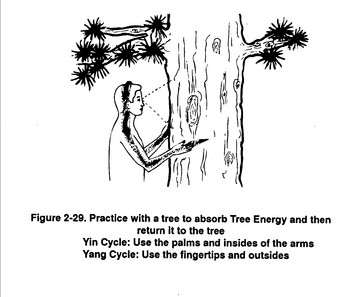
	<b>a.Use the Palms to Absorb Yin Chi and Help Balance Yang Energy (Figure 2-29)</b><br />
Morning to noon time is the best time to practice with a tree.</p>

<p>1.<i> Assume a Position</i>. Stand or sit one or two feet in front of a tree.</p>

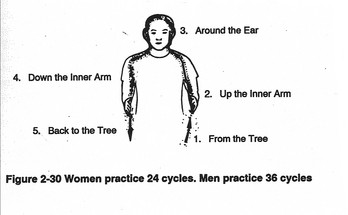
<p>2. <i>Open Yourself to a Tree</i>. Relax and center yourself. Feel your boundaries soften. Allow yourself to become more receptive and somewhat vulnerable, ready to make contact with the tree. Feel your energy field open like a flower, neither emitting nor absorbing energy, just becoming open and available (Figure 2-30).</p>

<p>3. <i>Offer a Welcome</i>. Extend your arms and face the palms of your hands toward the tree. Extend your energy toward the tree with a friendly &#8216;offering&#8221; attitude. When the tree responds by extending its energy to you, accept it, breathing it into your body with an attitude of &#8220;welcome.&#8221; Use your mind and eyes as follows. With the lower part of the eyes, concentrate on the tip of your nose. With the upper part of the eyes, look at your palms and at the tree.</p>

<p>Let your intuition guide you as you respond to the tree again with another &#8220;offering&#8221; gesture. Proceed with several of these exchanges. Take your time and really feel what is happening.</p>

<p>Use the left palm, the mind, and the upper part of the eyes to absorb the Chi.</p>

<p><img src="http://www.dharmacafe.com/images/uploads/CNTa_thumb.jpg" alt="image" width="349" height="297" /></p>

<p>4. <i>Parallel Tracking</i>. Remain centered within yourself, neither approaching nor retreating, and simply observe the subtle relationship between you and the tree. Use meditative concentration to become very absorbed in your connection with the tree, without actively trying to change or analyze what is going on. Do not try to deepen the communion or lessen it. Control your own energy and watch the tree while the tree controls its own energy and watches you. This is known as Parallel Tracking. Such a neutral state may occur several times during a session at deep as well as shallow levels of intimacy.<br />
 
5. <i>Draw and Hold Close</i>. Allow the energy field between you and the tree to intensify, thicken, and contract to Draw and Hold Close the two of you together. There may or may not be physical movement involved. The sensation is that the two of you are being enfolded in a cocoon of energy while more and more of your inner cores are exposed to each other. Finally you hold each other in an embrace of deep intimacy.</p>

<p>Drawing and Holding Close often happens spontaneously as the offering and welcoming escalates to become circulating and sharing, or as the circulating and sharing moves to deeper and deeper levels.</p>

<p>6. <i>Guide the Chi</i>. As with all Healing Tao practices, it is necessary that you train your eyes and mind to move and guide the Chi. This practice is also useful in training yourself to recognize and be aware of the quality of the tree&#8217;s energy. Feel the tree&#8217;s energy when it enters your body. As you send it out to the tree, combine it with Human Plane (Cosmic Particle) Energy. Notice how the energy feels when it returns to you from the tree: enhanced with a cool, healing quality. Notice also how the quality of the energy changes after nine, eighteen, 24, and 36 cycles.</p>

<p>Move the upper part of the eyes to guide the Chi slowly up the inside Yin side) of the left arm, to the left shoulder, the left side of the neck, the left ear, and the crown. From the crown move the Chi down the right side to the back side of the right ear, to the right neck, the right shoulder, inside the right arm, to the right palm. Project the Chi out into the tree trunk. Absorb the Chi again in a circle (the Yin Energy Circle): 36 cycles for men and 24 cycles for women. (Figure 2-30)			<br />
								<br />
7.&nbsp; <i>Extend to a Deeper Level.</i> Now begin to exchange energy with the tree on a deeper level. To share with the tree on a deeper level means to place a particular part of your body in contact with a particular part of the tree&#8217;s body, and breathing the energy back and forth between them. To circulate now means guiding the energy along a path which passes through both of your bodies and returns to its starting point. You can guide the Chi as in (6) above. Eventually you will discover many different patterns are possible.</p>

<p>8.&nbsp; <i>Drawing and Holding Back to End Gracefully.</i> Drawing and Holding Back is very important. It prevents you from absorbing more energy from the tree than you can harmoniously utilize. It also prevents you from draining too much energy from a small or weak tree, or leaving such a tree with too much of your unprocessed negative energy. In addition, it seals off the connections you have made with the tree so that energy is not leaked into the environment after you leave. All in all, it makes for an aesthetically complete meditation and shows respect for the tree. When you have had enough and wish to begin your return to normal consciousness or just to a less deep level of communion, try to do so slowly and gradually so as not to disturb the beauty of what you have just shared. The sensation is one of gradually returning to yourself, sorting out the energy that belongs to you from the energy that belongs to the tree, and re-establishing the boundary between you.</p>

<p>It is important to note at this time that if, after you have done the healing, you still feel a lot of energy in your hands, close the crown point to seal it so that your healing energy will not continue to flow out.<br />
 {pagebreak}<br />
Trees have a great liking for human contact and you will probably be ready to go long before the tree is ready to have you leave.</p>

<p>	a. You need to gradually withdraw your attention from the contact, and turn your attention more upon yourself.</p>

<p>	b. As you do this, much of the shared energy will be drawn into your body. When this happens, just &#8220;push back&#8221; at the stream of tree energy to prevent most of it from entering your body while allowing your human energy to return.</p>

<p>	c. Then, when your polarities reverse, allow the tree energy to flow back into the tree, but keep your own conscious energy within your body.</p>

<p>	d. After a couple of exchanges, the tree will get the idea and begin to cooperate with you. In a little while you will be fully back in your own body and ready for the closing.</p>

<p>	e. To disengage from a powerful circulation pattern, gradually focus your attention on the navel area, the place to end the meditation. As the energy collects there, allow any excess to flow into the tree.</p>

<p>	f. If the tree tries to feed you energy from another point, push back at this flow in the manner described above.</p>

<p>	g. Eventually the pattern will cease, and you will be sharing energy with the tree at the selected point. Now you can sort out what energy belongs to you and what belongs to the tree to complete the drawing back.</p>

<p><br />
	h. When you are very deep into communion with a tree, you will probably have &#8220;too far to go&#8221; to draw back in one step. Instead, after a partial drawing and holding back, resume circulating and sharing, but in a less intense manner. Gradually, after several of these steps, you will some wholly back to yourself. </p>

<p>9. <i>Closing</i>. Always end with a closing. The closing is a precise and somewhat abrupt gesture which breaks the connection, locks into place any healing that may have occurred, and imparts a feeling of good will, all within a second or two. The closing may be a movement, a sound, or just a change in the subtle energy field, such as the clap of the hands, or a nod of the head. A smooth movement of a fist in an upward arc, ending with a little downward punch is very effective. The sounds &#8220;Ho&#8221; or &#8220;Amen&#8221; used to end prayers are also examples of closing gestures. So is a firm handshake, or a little squeeze at the end of a hug. Follow this with a little wave of the hand, or a quick kiss on the trunk to complete your closing.<br />
Sections (7), (8), and (9) above are used to intensify, slow down, and end the exercises below and can be used at any time to end your communication with your selected tree.</p>

<p><b>b. Use the Fingers to Absorb Yang Energy to Help Balance the Yin Energy (Figure 2-29</b>)</p>

<p>1.&nbsp; Stand approximately one to two feet in front of a tree. Move slowly and smoothly, gradually approaching the tree. Feel the field of energy surrounding you become thick like honey.</p>

<p>2.&nbsp; Extend your arms out toward the tree with your palms facing the tree and your fingers extended.</p>

<p>3.&nbsp; As you slowly adjust your position to be closer and closer to the tree, less &#8220;honey&#8221; separates you from the bright energies found at its core.</p>

<p>4.&nbsp; Similarly, your own radiance is revealed to the tree.</p>

<p>5.&nbsp; At the same time the honey-like energy surrounding you acts like a protective cocoon, and your awareness of the outside world fades. As you arrive at the tree and wrap yourself around it in a big hug, your radiant energies link up with each other and you may lose yourself for a few moments in the bliss of union.</p>

<p><img src="http://www.dharmacafe.com/images/uploads/CNTb_thumb.jpg" alt="image" width="348" height="215" /></p>

<p>6.&nbsp; After making contact in this way, you may need to hold still for a while until the new, deeper connections between you and the tree stabilize and simplify. Soon you will find yourself in the state of parallel tracking described previously from which circulating and sharing will develop.</p>

<p>7.&nbsp; Feel the energy of the tree first. When you feel the tree&#8217;s Chi, use the mind, eyes, and lower part of the eyes to concentrate on the tip of the nose. The upper part of the eyes looks at the tips of the fingers and the tree.</p>

<p>8.&nbsp; Use the left fingers, the mind, and the upper part of the eyes to absorb the Chi inward.</p>

<p>9.&nbsp; Move the upper part of the eyes slowly to guide the Chi up the outside (Yang side) of the left arm, to the left shoulder, the left side of the neck, and the left ear to the crown. Move the energy down the right side beginning with the back side of the right ear, to the right neck, the right shoulder, outside the right arm, to the right palm and fingers. Project the energy out from the fingers, combine it with Cosmic Particle Energy, and guide it into the tree trunk. Absorb it again in a circle. Men repeat the cycle 36 times; women repeat the cycle 24 times. (See Figure 2-30)</p>

<p>10.&nbsp; If you wish to end the experience at this or any point, follow the procedures of (a)(7), (8), and (9) above to intensify, slow down, and finally break your connection with the tree.<br />
 {pagebreak}<br />
	The Yang Energy Circle will help you become more sensitive to chronic and more superficial pain as well as the energy in the Yang organs (large and small intestines, gall bladder, bladder, and stomach).</p>

<p><b>c. Use the Palms to Absorb Tree Chi; the Yin Side</b></p>

<p>1.&nbsp; Sit or stand approximately one to two feet in front of a tree.</p>

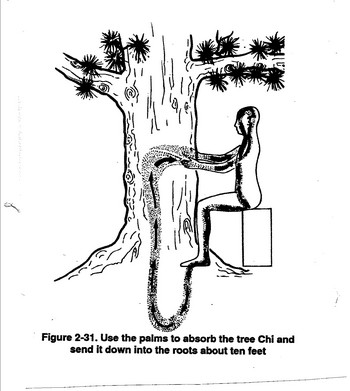
<p>2. Extend your arms out toward the tree with your palms facing the tree. (Figure 2-31)</p>

<p>3. Feel the energy of the tree first. When you feel the Chi of the tree, use your mind, eyes, and palms to absorb the Chi through your palms. Move the Chi up the inside (the Yin sides) of both arms to both shoulders, both sides of the neck, and the left and right ears, to the crown. From the crown move the energy down the Functional Channel to the mid-eyebrow, throat, heart, solar plexus, navel, and the cauldron behind the navel. </p>

<p>4. Continue to move the energy down from the cauldron to the perineum, to the soles of the feet, and then approximately ten feet into the ground.</p>

<p>5. Bring the energy up to the roots of the tree, then up into the tree trunk. Feel your energy flow through the tree, then emerge from the trunk into your palm. Repeat the cycle nine, eighteen, 24, or 36 times.</p>

<p>6. Practice sending your energy through the tree trunk from the right palm, through the tree, to the left palm, and from the left palm, through the tree, to the right palm. Men should practice for 36 cycles; women should practice for 24 cycles. It is most important to feel your energy penetrate the tree.</p>

<p><img src="http://www.dharmacafe.com/images/uploads/CNTuno.jpg" alt="image" width="350" height="391" /></p>

<p>7.&nbsp; Practice distinguishing different parts of the tree. Start with the upper trunk. Send your energy into the trunk and feel it reverberate. Slowly kneel down to practice with the lower trunk. Then practice with the roots of the tree. Feel and exchange the force with the tree.</p>

<p><b>d. Absorb Tree Chi through the Crown</b></p>

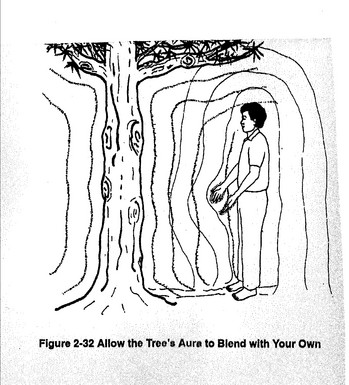
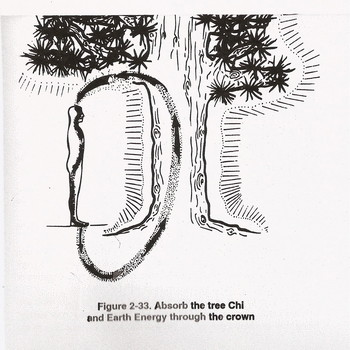
<p>1.&nbsp; Stand approximately two to three feet in front of a tree with your arms at your side. Feel the tree&#8217;s aura. (Figure 2-32) If you do not feel it, you can move in closer.</p>

<p>2.&nbsp; When you feel the tree&#8217;s aura, use your crown to absorb the energy. The tree&#8217;s balanced energy can feel very gentle and soft and have a very powerful healing effect.<br />
 
<img src="http://www.dharmacafe.com/images/uploads/CNT2.jpg" alt="image" width="349" height="385" /></p>

<p>3.&nbsp; Draw the tree energy into your crown and let it flow down through the Thrusting Channels or through the Functional Channel to the perineum, then down to both feet. Move the energy out through the soles of your feet into the ground. Bring the energy from the ground to the roots of the tree, then up its trunk.</p>

<p>4.&nbsp; Feel yourself absorb the Earth Energy and the tree energy. (Figure 2-33) Feel them purify your energy, removing negativity and sick energy. When you feel it emerge from the trunk of the tree, absorb the Human Plane (Cosmic Particle) Energy, and return the energy to your crown. You will feel the combined energies nourish your brain, glands, and organs. Repeat the process nine, eighteen, or 36 times.<br />
 
<img src="http://www.dharmacafe.com/images/uploads/CNT3.jpg" alt="image" width="350" height="350" /><br />
 {pagebreak}<br />
<b>e. Share with the Tree from the Heart</b></p>

<p>In this pattern tree energy is run through the arms and heart center. It may be used to clear a healer&#8217;s arms of sick energy accumulated in work, or just to open the heart.</p>

<p>1.&nbsp; Assume any comfortable position in which your hands can easily reach a branch.</p>

<p>2.&nbsp; Reach one arm out to touch the tree with the palm or fingertips. Feel the vital energy just under the bark and make contact with it, allowing some time for the contact to develop.</p>

<p>3.&nbsp; After a while you will feel the sharing begin as a gentle breathing back and forth between your hand and the tree.</p>

<p>4.&nbsp; Gradually extend the process until you are breathing energy through the entire length of the arm, back and forth from your heart center to the tree. Let this back and forth sharing go on for some time.</p>

<p>5.&nbsp; Next, get the other arm involved. It may rest on the same branch, near the other hand, or it may rest on an entirely different branch.</p>

<p>6.&nbsp; Allow the tree energy to flow in along one arm, mix with your own energy in the heart center, and flow out the other arm. Every so often reverse the direction of flow in one or both arms.</p>

<p>7.&nbsp; For a deeper experience try extending the flow from the heart down to the navel, letting it go from tree to heart, to navel, and back.</p>

<p>8.&nbsp; Where does the energy go after it leaves your hands and enters the tree? By following it with your mind, you will begin to discover more about the subtle anatomy of the tree.</p>

<p>9.&nbsp; You may find blocked or congested areas that you can work on by running energy out one hand and into the other. Feel the tree&#8217;s response to your efforts, and let intuition guide you.</p>

<p><b>f. Absorb Earth Energy</b></p>

<p>1.&nbsp; Create warmth in your navel and bring the energy up to the crown.</p>

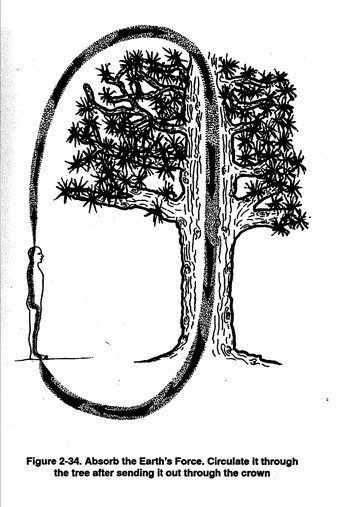
<p>2.&nbsp; Project the Chi out into the top of the trunk of the tree. Enter the tree and feel that you have a connection with it.</p>

<p>3.&nbsp; During this process you can stand farther away from the tree (ten to thirty feet). As your practice continues you can project your energy easily from far away into the tree. Let the tree take in your negative or sick energy. The energy you receive back will be balanced.</p>

<p>4.&nbsp; Let your energy flow down the trunk of the tree to its roots and into the Earth. (Figure 2-34) Let the Earth Energy purify your energy. Bring this combined energy up through the soles of your feet to the perineum, then up through the Thrusting Channels, or through the Governor Channel running up the spine. Let the energy flow up to the crown and project it outward again. Repeat the process nine, eighteen, or 36 times.</p>

<p><img src="http://www.dharmacafe.com/images/uploads/CNT4.jpg" alt="image" width="350" height="507" /><br />
The more you repeat the process, the more your energy will refine and increase. You will notice the Thrusting Channels and the Microcos&#172;mic Orbit are cleaner and brighter. Once you have established a good connection with the tree, you can send your sick energy to the tree from a far distance to refine your energy or improve your health.</p>

<p> <br />
<b>g. Meditate While Sitting Under a Tree</b><br />
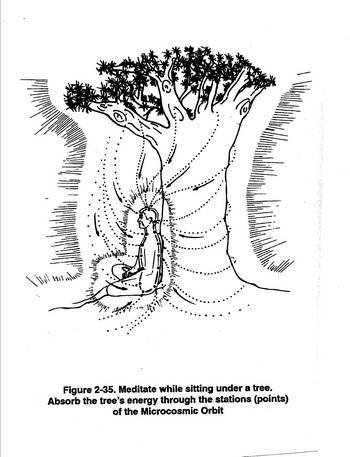
Once you have developed the ability to feel the tree&#8217;s Chi, you can sit under the tree and meditate. Draw the tree&#8217;s energy into you through the stations (points) of the Microcosmic Orbit. (Figure 2-35)</p>

<p><img src="http://www.dharmacafe.com/images/uploads/CNT5.jpg" alt="image" width="350" height="457" /></p>

<p>
</p>
      ]]></content>
    </entry>

    <entry>
      <title>Descartes and Animals: What if they also think?</title>
      <link rel="alternate" type="text/html" href="https://dharmacafe.com/gaia/descartes-and-animals-what-if-they-also-think/" />
      <id>tag:dharmacafe.com,2008:gaia/19.1913</id>
      <published>2008-08-30T16:45:01Z</published>
      <updated>2008-09-01T20:20:16Z</updated>
      <author>
            <name>Bill Stranger</name>
            <email>comments@christinesuzuki.com</email>
                  </author>

      <content type="html"><![CDATA[
         <p>It was the middle of the night when their howling woke us. Yips, cries, howls, excited barks&#8212;sounds that some find disconcerting, but that I love. Sounds of joy, aliveness, uncontrolled and uncontrollable wildness. On this night, however, Kathleen and I sat bolt upright in bed. Where are Farley Mo and Zuffa? Kathleen and her cats had just recently moved from a city lot in Seattle to this outpost in Northern New Mexico, on the edge of the real world&#8212;the wilderness&#8212;with coyotes, hawks, owls, bobcats, lynx, and mountain lions, any one of which would love to eat a cat for dinner.</p>

<p>Sometimes those exuberant coyote cries mean they&#8217;ve just killed their next meal, and these coyotes sounded about fifty yards behind the house. We weren&#8217;t sure how well these city cats understood the risks they faced here in the wild. So we jumped out of bed, ran outside, and called the cats. Zuffa showed up rather quickly, but we saw no sign of Farley Mo. We headed towards where we heard the coyotes, but saw no cat, no coyotes, and fortunately, no blood or other signs of a kill.</p>

<p>Back at the house, Zuffa sat calmly on the deck. &#8220;Farley,&#8221; we called, but no sign, no answer. &#8220;Zuffa, where&#8217;s Farley Mo,&#8221; I asked. Zuffa looked casually towards his left, towards the east end of the deck. Was that an intentional look, I wondered, but then dismissed the thought. &#8220;FARLEY. . . . FARLEY MO!&#8221; we cried. Kathleen was beside herself. I did have an instinctual belief in the cats&#8217; inherent understanding of the prey-predator relationship, since cats walk both sides of that line, but still I was worried.</p>

<p>&#8220;Zuffa,&#8221; I asked again, &#8220;where is Farley Mo?&#8221; Zuffa looked at me and calmly walked to the end of the deck and sat down, looking towards the clump of oaks just off the end of the deck. I walked over by Zuffa and called Farley Mo again, and here he came, calmly walking out of the oaks. Of course! I realized. Of course Farley had been in the oaks, either in a tree or ready to climb if needed. Of course he knew what to do. And, of course, Zuffa not only knew exactly where Farley was, but he also had answered me clearly, each time I had asked. First, with a look that would have sufficed if I had given him the credit he deserved, that he was not only conscious and aware, but also quite able to receive and give communication. And secondly&#8212;probably with the cat&#8217;s version of rolling his eyes at my human flaw, my inability to communicate as well as my human conceit&#8212;he used a clearer indication, perhaps as we might with a child, by walking to the end of the deck.<br />
 
With humiliation and gratitude, I thanked Zuffa and apologized for not &#8220;listening&#8221; to his first answer. And I filed this alongside my other encounters with cat intelligence. For this was not my first encounter, not by a long shot&#8212;though it was one of the more profound, more clear examples of communication in both directions. I had long known that cats were conscious, thinking, emotional beings, yet I still fell into our species&#8217; trap, the trap which I learned through my &#8220;scientific&#8221; education as a veterinarian. Even though I had inklings of cat consciousness prior to and during veterinary school, the Cartesian animals-as-instinctual-beings-only model settled deeply into my brain, and I can easily slip back into that mode whenever I drop out of conscious living.</p>

<p>Ren&#233; Descartes, whose most famous quote is, &#8220;I think, therefore I am,&#8221; also stated that animals acted merely by instinct, and that even their cries during vivisection came as reflexes rather than from pain as humans experience. This was a ghastly error that reverberates even today in animal research, as experiments worldwide subject millions of animals to terrible pain in the name of science. But that&#8217;s another story.</p>

<p>Descartes arguably gifted humankind greatly, as his rational thinking turned a corner and led us into scientific thinking and experimentation. His reasoning presaged the scientific method and logical approaches to the rational sciences. This opened the doors for tremendous gains in understanding our world; this understanding underpins all modern science, and even all western thought. It comes at a price, though, for the shift has been complete. In developing our logical sides, we&#8217;ve abandoned intuitive understandings; we now relate to our world completely differently than we did for countless millennia prior to Descartes&#8212;basically since humans first began to walk this earth. Descartes did not initiate this shift, which had been evolving for a few thousand years, but his reasoning provided the tipping point. Prior to him, rational thought occurred mostly within a context of intuitive consciousness.<br />
{pagebreak}<br />
Before humans shifted into rational thinking, we saw our world as reflections of us; we knew we existed as a part of the great web of existence. And we therefore understood that non-human animals are different from us in degree only. We did not see ourselves as distinct, as a completely separate species. We knew that other animals operate with awareness, understand the world in different, sometimes superior ways, and respond consciously to the world. We saw them with compassion. </p>

<p>But we&#8217;ve left that behind since Descartes. We still, as a society, see non-human animals as instinctual, reflexive beings. At least that&#8217;s the official line. I grew up with this mindset. While I grew up with cats, the occasional dog, monkeys, hamsters, and so on, I observed them through this rational, scientific filter and interpreted their actions from within its framework. I especially enjoyed cats, and spent many happy hours petting and observing them&#8212;still I never really saw them. At least, most of the time. Occasionally, they jolted me awake with behaviors I couldn&#8217;t explain as instinctual.</p>

<p>My first lesson occurred when I was twelve. We had two male cats in our household, both un-neutered. Smokey, a Siamese, was &#8220;mine,&#8221; while Soot, a gray tiger, held my sister as his primary human. Smokey, like Michael Jackson, was &#8220;a lover, not a fighter.&#8221; Soot, however, was the bully on the block, and regularly attacked Smokey as well as other neighborhood cats, often at night, the peak time for nocturnal animals. On one of these nights, the squalling came from the back porch, close enough and loud enough to wake me. It was winter and new snow and ice covered the porch, where Soot had Smokey cornered. </p>

<p>I ran out the back door onto the frozen porch in my pajamas and bare feet to break up the fight. I grabbed Smokey up into my arms and turned back to the door. As I reached for the handle, I felt a sharp sting on my leg, and then several stings, where Soot had wrapped his legs around mine, digging in with his front claws while biting me on the calf. I jumped, slipped on the ice, and tumbled, scattering both cats in the act. I partly fell on Soot, who scooted into the night. Snatching Smokey, I ran inside, stunned by this turn of events. </p>

<p>Smokey and I retreated to my bedroom, where I lay wide awake, not from my wounds, but in awe of Soot&#8217;s inexplicable action. I hadn&#8217;t been schooled enough yet to simply dismiss this as redirected aggression, or as an instinctual attack on me in an attempt to get at Smokey. No, even at twelve I knew this went much deeper, that Soot likely knew full well who and why he bit in that last, frustrated attack. It was quite clear he was pissed at me for getting in the way, and this implied a much deeper awareness, a consciousness I had never heard discussed and cannot say I had experienced before. It was one of those moments where the world shifted slightly off its axis, where things were no longer as they had been. And yet, it was dreamlike enough that I also wondered if it was true. Not whether Soot had bitten me&#8212;of that I had ample proof. But was it true that he did so consciously? I felt sure it was, but I hadn&#8217;t enough awareness myself to properly integrate this knowledge, and there was no one with whom I felt I could discuss my experience.</p>

<p>In fairness, at twelve I was not really aware of my own consciousness. I did know, however, that I thought about my actions, that I responded emotionally to others&#8217; actions. I knew that I participated in my life with awareness, though I hadn&#8217;t taken time to consider this awareness. My teachers and my elders, in contrast, all said that animals acted only through instinct, like the baby chick who imprints upon whatever it sees upon emerging from its egg, accepting that as its mother.</p>

<p>With that background, I stewed upon Soot&#8217;s actions for a few weeks. I had never seen such behavior in an animal. I found it puzzling, yet I could also imagine reacting similarly if I were in his place. His reaction seemed so human. And there&#8217;s the clue: emotional and conscious responses I thought limited to humans; so I thought his behavior human-like when it appeared conscious, emotive. There&#8217;s the bias, right in our language, right in my thoughts.</p>

<p>My next lesson came during veterinary school, from Isabel, a stocky black female who&#8217;d shown up as a stray kitten at our student housing apartment. My wife and I both loved animals, so we took Isabel in immediately, despite rules forbidding pets in campus housing. It wasn&#8217;t in rebellion; we simply saw a cold, hungry kitten and brought her inside, not even considering the rules. We quickly became attached, and that was that. Isabel was independent and a bit ornery, but also a very nice cat. She just liked her space. One evening, as we sat down after dinner, I picked Isabel up to hold her, but apparently she did not want to be held, and so she scratched me, swatting my nose with her claws, drawing blood. I put her down, my feelings hurt, and said, &#8220;Fine, Isabel, be that way. I&#8217;ll just leave you alone from now on.&#8221; She ran into &#8220;her&#8221; room&#8212;our spare bedroom, where she spent many hours in solitude.</p>

<p>I&#8217;d grown up with cats and had always connected easily with them. But, in a sense, I only saw them as living, breathing stuffed animals. Something to pet, to cuddle, to love&#8212;on my own terms and without real concern or awareness that they had their own desires and needs, which might be different from mine. I thought they liked me and always wanted me to pet them.</p>

<p>Isabel&#8217;s reaction not only surprised me, but I also felt hurt by her rejection. I was so unaware that I hadn&#8217;t even noticed that she did not want me to pick her up. I didn&#8217;t see her as Isabel; rather I saw her as a cat, and in my mind, cats liked attention, liked petting. <br />
 {pagebreak}<br />
To be fair to myself, the cats with whom I&#8217;d grown up generally had enjoyed petting&#8212;or, at least, had not resisted so forcefully, so clearly. They&#8217;d had different names, but acted enough alike to assume they were the same. It took Isabel to say, &#8220;I am an individual, I have needs, and I don&#8217;t have to subsume my needs to yours.&#8221; I learned a lot from her response. Isabel&#8217;s needs led her to &#8220;speak her mind&#8221; in the ways at her disposal. She first expressed her desires with body language, which in my ignorance I either missed or ignored. Her only other option was to strike, at least in her mind.</p>

<p>The most interesting part, though, is that, within just a few minutes, Isabel came right back out of her room  and strode over to the sofa, jumped onto my lap, and settled down. This was not common. Again, my brain whirred as this new information tried to find a place to settle into, though space was limited by my ongoing veterinary education. Still, I clearly saw conscious awareness here, as with Soot. Could I say Isabel felt remorse, or that she was apologizing to me? At the time, it seemed pretty clear that her expression was something like this. Her actions were clearly intentional, and she came right back to me like a moth to a flame. It was not an accident; this much was certain. My world rocked off kilter again, if only for a short time. I finally had to put the experience into a closet with the other ones, as they did not mix with my schooled understanding. I don&#8217;t mean that I consciously set these things aside, only that they stayed in limbo, as oddities that did not fit, and slowly got buried under mounds of anatomy, physiology, biochemistry, microbiology, and other medical data. Veterinary school required all of my attention, or at least enough, that I had not the luxury for philosophical speculation at the time.</p>

<p>And then there was Nikki. Nikki lived with my friend Annelise. Nikki reminded me of Isabel: stocky, feisty, and fiercely independent. Yet she also interacted with everyone, and people always liked her fiery and friendly nature. She loved to be in the middle of the action. Like an actor who just loves the limelight, Nikki loved to be seen. She craved attention, but not necessarily pets, and she drew clear boundaries when she&#8217;d had enough.</p>

<p>Annelise lived in an A-frame house, with its tall, sloping roof and high ceilings. A freestanding set of upper and lower cabinets, with barstools on either side, divided the kitchen from the dining area. All five cats loved to perch on top of the upper cabinets.</p>

<p>One day, I sat across this counter from Annelise, when, out of nowhere, here came Nikki, charging into the kitchen, up onto the countertop, and then she leapt up to the top of the upper cabinets. Except she missed. She apparently misjudged her jump and did not quite make the top, and then she fell back to the countertop unhurt, on her feet. At that, Annelise and I couldn&#8217;t help but burst out laughing. With Nikki&#8217;s reputation and the obvious bravado with which she had intended to take to the top in two bounds from the floor, we just looked at each other and howled.</p>

<p>Nikki took a quick look at me, then ran over to Annelise and smacked her on the arm before tearing off into the bedroom. And, of course, that pushed us over the top as we had to hold onto the counter to avoid falling off the stools in teary-eyed mirth.</p>

<p>And yet, here was another message from CAT, the collective being of cats with whom I have shared my life: We are conscious. We are sentient. We think, we know, we feel. We are like you. We think, therefore we are.</p>

<p>Nikki clearly was embarrassed, had her feelings hurt, or something similar, and she was offended at our laughter at her expense. Who wouldn&#8217;t be? Whether she knew it was because of her feisty spirit, and really in fondness for that feisty spirit, I don&#8217;t know. What I do know, what these animals have shown me, is that I can no longer pretend that they are unaware. I have no choice but to see them as equal to me: equally conscious, equally valuable, equally an expression of whatever magnificent force manifests this world.</p>

<p>I&#8217;ve since seen numerous cases wherein cats and dogs show discomfort when humans laugh at them. I can&#8217;t say it&#8217;s always stopped me from laughing at animals when their behavior appears funny, any more than always refraining from laughing at fellow humans, or even at myself. We all take ourselves much too seriously. But I can say that I now retain a sensitivity to animals&#8217; feelings and attempt to judge when it&#8217;s OK to laugh and when it is better to restrain my mirth, as I would do with human friends.</p>

<p>I&#8217;ve learned so much from the animals with whom I&#8217;ve had the fortune to share this life. Their exuberance brings endless joy. Their general&#8212;but not complete&#8212;non-judgment about me remains a model I struggle to emulate. And it&#8217;s because I know they are sentient that their behavior glows so brightly, that their acceptance is all the more impressive. If they were the instinctive, animated machines whom Descartes described, who bear the brunt of human blundering via animal research, ecological wasting, abuse, and neglect, it would not mean so much. But to know that these animals think, perceive, and feel in ways that are so similar to me, brings me greater joy in my interactions with them while, at the same time, it pains me to know how they suffer at our hands. They give so much comfort to me, to so many in this modern world. We&#8217;re so estranged from anything natural&#8212;from nature. Carl Jung believed that nature could cure almost any of our ills, at least our mental and emotional ills. It&#8217;s certainly true for me. But most people haven&#8217;t the luxury to live as close to nature as I do.</p>

<p>Companion animals provide this link to nature, and in this their service is invaluable. Unfortunately, though, our conditioned perception of them as instinctual beings not only limits them&#8212;limits their lives and their freedoms&#8212;but it also limits the value we can gain from interacting with them. Becoming aware that these animals interact with me similarly to how I interact with them brings their gift to an entirely new and more profound level. I know it&#8217;s a privilege and a grace to share my life with them. </p>

<p>I used to see them as beneath me. Not in value and not even consciously, but subliminally I saw them as less complex, less aware. This belief that they only instinctually relate to their world conferred this perception on me. Our society imprints this belief in us all. Thankfully, interactions like the ones I have described have changed this. I now see them as at least equal, and in many ways superior to me, to humans. For it is we, more than they, who blunder unconsciously through life, not seeing any others, human or non-human, in our quest for satisfaction. We push ourselves and our entire world to the brink in this reflexive, instinctual drive for satiation. It&#8217;s beyond survival, it&#8217;s more like insanity in action as we career through life like bumper cars, bouncing off whatever is in our path. If we only realized how deeply these animals feel, what they know, we would act more respectfully towards them, we would treat them as we like to be treated. And we would likely obtain at least some of what we unconsciously seek. Unfortunately, though, unlike the bumper cars, where no one or no thing gets hurt, we hurt these beings around us, and in so doing, we hurt ourselves&#8212;since, as we slowly begin to relearn our lost understanding, we see that they and we are one.</p>

<p><i>Don Hamilton practices veterinary homeopathy and is the author of Homeopathic Care for Cats and Dogs: Small Doses for Small Animals.<br />
</i></p>


      ]]></content>
    </entry>


</feed>