<?xml version="1.0" encoding="utf-8"?>
<feed xmlns="http://www.w3.org/2005/Atom" xml:lang="en">

    <title type="text">Nature Psyche Supernature</title>
    <subtitle type="text">Nature Psyche Supernature:</subtitle>
    <link rel="alternate" type="text/html" href="http://www.dharmacafe.com/nature-psyche/" />
    <link rel="self" type="application/atom+xml" href="https://dharmacafe.com/nature-psyche/atom/" />
    <updated>2014-12-06T19:07:31Z</updated>
    <rights>Copyright (c) 2013, Bill Stranger</rights>
    <generator uri="http://www.pmachine.com/" version="1.6.9">ExpressionEngine</generator>
    <id>tag:dharmacafe.com,2013:12:23</id>


    <entry>
      <title>Richard Grossinger: The DharmaCafe Interview</title>
      <link rel="alternate" type="text/html" href="https://dharmacafe.com/nature-psyche/a-conversation-with-richard-grossinger/" />
      <id>tag:dharmacafe.com,2013:nature-psyche/15.8153</id>
      <published>2013-12-23T10:04:30Z</published>
      <updated>2014-12-06T19:07:31Z</updated>
      <author>
            <name>Bill Stranger</name>
            <email>comments@christinesuzuki.com</email>
                  </author>

      <content type="html"><![CDATA[
         
      ]]></content>
    </entry>

    <entry>
      <title>&#8220;Why haven&#8217;t we seen a picture of the whole mind yet?&#8221;:&amp;nbsp; Positive Possibilities for Psychedelics</title>
      <link rel="alternate" type="text/html" href="https://dharmacafe.com/nature-psyche/why-havent-we-seen-a-picture-of-the-whole-mind-yet-positive-possibilities-f/" />
      <id>tag:dharmacafe.com,2010:nature-psyche/15.5890</id>
      <published>2010-02-10T19:06:07Z</published>
      <updated>2010-02-16T01:00:08Z</updated>
      <author>
            <name>Bill Stranger</name>
            <email>comments@christinesuzuki.com</email>
                  </author>

      <content type="html"><![CDATA[
         <blockquote><p><i>The chemicals of transformation of revelation that open the circuits of light, vision, and communication, called by us mind-manifesting, were known to the American Indians as medicines: the means given to men to know and to heal, to see and to say the truth.</i><br />
&#160;&#160;&#160;&#160;&#160;&#160;&#160;&#160;&#160;&#160;&#160;&#160;&#160;&#160;&#160;&#160;&#160;&#160;&#160;&#160;&#160;&#160;&#160;&#160;&#160;&#160;&#160;&#160;&#160;&#160;&#160;&#160;&#160;&#160;&#160;&#160;&#160;&#160;&#160;&#160;&#160;&#160;&#160;&#160;&#160;&#160;&#160;&#160;&#160;&#160;&#160;&#160;&#160;&#160;&#160;&#160;Henry Munn</p></blockquote><p> </p>

<p>For those of us involved with psychedelics, this is a time of unexpected changes, a time to celebrate but only tentatively. After decades of winter, the ice is thinning. The warming trends toward legalization, increased religious, medical and psychotherapeutic use, scientific exploration and cultural acceptance are encouraging. </p>

<p>After so many years, why now? Perhaps, because the generation that suppressed research, criminalized personal use and jailed users is passing from power. This next generation is better able to admit to the ineffectiveness of the legal clampdown and to temper it. It is much easier for those who never voted for the current laws to recognize that some, passed in haste and ignorance, are unworkable and counter-productive. </p>

<p>While the agenda of the research community has focused on a restoration of therapeutic use , the most striking changes have been in the legal status of private personal use. The community of nations seems to be shaking off the fear induced by the excesses of the sixties, the phobic response of the American government and the pressure from the United States on other nations to follow its lead. Like wild flowers coming up through cracks in concrete, more countries are starting to set their own policies. </p>

<p>The Netherlands has long allowed some psychedelics to be quite easily available but s stopped short of formal legalization. Portugal legalized all drugs in 2001 and made it explicit that that treatment would be available for any drug user needing it. The naysayers fretted that this would have terrible consequences, but results have been entirely beneficial: less addiction, less social disruption, less crime, less actual use, more treatment facilities and huge savings in law enforcement.&nbsp; Mexico legalized small amounts of all previously illegal drugs in 2009. This was done, in part, to free up resources to try to eliminate criminal drug cartels. Since illegal addictive drugs, including cocaine, heroin and their derivatives, are grown primarily for the United States market; the focus is now to minimize cross-border activities. The Czech Republic relaxed its laws to the point that many psychedelic plants may be owned or grown legally. It has also relaxed its penalties for possession of small amounts of manufactured substances like MDMA.&nbsp; <br />
The basis for these reforms is the recognition of the following realities: </p>

<p>&#160;&#160;&#160;&#160;&#160;l. Psychedelics are not addictive; they never were. </p>

<p>&#160;&#160;&#160;&#160;&#160;2. Marijuana unlike, tobacco and alcohol, does not cause systemic medical syndromes. In the Unites State alone, tobacco&#8212;legal, addictive and regulated&#8212;-directly contributes to the deaths of 400, 000 people a year while marijuana&#8212;illegal, non-addictive and unregulated&#8212;(and perhaps used by more Americans than still smoke cigarettes) does not kill any. </p>

<p>&#160;&#160;&#160;&#160;3. Illegal drugs are crime and violence magnets. It was true when the United States prohibited alcohol; it is equally true of any other desired and prohibited substance. If you remove criminal penalties for benign or at least non-addictive drugs, personal use actually declines&#8212;at least in Holland and Portugal, the only two countries for which we have data. The other equivalent statistics we have is that those states with medical marijuana laws have not seen a rise in total marijuana smoked, despite forecasts that we would made by those trying to stop those laws from going into effect.&nbsp;  &nbsp; <br />
&nbsp; {pagebreak}&nbsp;  &nbsp;  &nbsp;  &nbsp;  &nbsp;  &nbsp;  &nbsp;  &nbsp;  &nbsp;  &nbsp;  &nbsp;  &nbsp;  &nbsp;  &nbsp;  &nbsp;  &nbsp;  &nbsp;  &nbsp;  &nbsp;  &nbsp;  &nbsp;  &nbsp;  &nbsp;  &nbsp;  &nbsp;  &nbsp;  &nbsp;  &nbsp;  &nbsp;  &nbsp;  &nbsp; <br />
A second group of countries have not changed their laws, but their courts have ruled that their constitutions affirm the right to private, consciousness-changing activities. Courts in Brazil and Argentina have concluded that it is not legal to deny people the right to personal use of whatever substances, as long as it does not lead to socially unacceptable or criminal behavior.</p>

<p>The third group of countries, still uncertain what direction to take, includes the United States. In the United States, policies that lumped marijuana, psychedelics and addictive drugs together led to a bulging jail population, the proliferation of highly profitable international criminal activities, distortion of the national economy in countries producing illegal drugs for American consumption and a growing disdain for government&#8217;s failure to cope with the situation. The added ill is that these policies cost billions of dollars annually. </p>

<p>In spite of the Washington&#8217;s reluctance to change, state after state has used their prerogative to allow people to use marijuana as a medication. Until the Obama Administration, the federal government did its best to subvert these laws and keep all marijuana users criminalized. An indication of the pent-up demand for legal medical use is that within a few weeks of the Administration&#8217;s decision to allow such use, compliant with state laws, eight hundred marijuana dispensaries opened up in Los Angeles alone, outnumbering the number of banks or public schools in the city. The trend toward legalization is accelerating as it becomes more and more self-evident that marijuana use does not lead to violence or to criminal behavior. That the last three presidents have smoked marijuana at one point in their careers has not been lost on reformers or the general public. Marijuana is not a psychedelic, but it is a consciousness altering substance used traditionally for spiritual and therapeutic purposes. As its status changes, it will make stronger consciousness altering plants and substances less likely to remain demonized. </p>

<p>Several states, notably California, but Nevada, Washington and Florida as well, are trying to put initiatives on their ballots to decriminalize or legalize marijuana. In California, the main argument is that marijuana production, though one of the state&#8217;s largest industries, is totally untaxed and that its interdiction is expensive and unsuccessful.&nbsp; The idea is to turn a sinkhole of wasted money into a source of revenue. The California proposition that already has enough signatures to qualify for the ballot makes possession of up to one ounce legal; it allows individual cultivation in a garden of no more than 25 square feet, forbids sales to minors and forbids smoking in public. The specifics of regulation and taxation are left to local jurisdictions. </p>

<p> In addition, and directly pertaining to psychedelics and religious freedom, several court cases have established that religious groups using ayahuasca as their central sacrament may practice their faith without fear of imprisonment. These cases are a first step toward the restoration of religious liberty regarding other psychedelics in other settings. </p>

<p>Even the nonsense of forbidding cultivation of hemp, as though it were marijuana, (comparable to putting root beer in the same class as Coors) has been getting a fresh look. Imported hemp products, including those for human consumption, are again available, and one state, Washington, following the example of Canada and a dozen other countries, allows hemp to be grown, harvested and sold. There seems to be, if not an end the lack of common sense in the regulatory establishment, at least some cracks in it. <br />
Making marijuana legal and taxable will greatly reduce the budgets and staff of the drug enforcement establishment&#8212;and its clout. The push back will come from the drug prohibition-law enforcement- private-prison-prison-guard complex, institutions whose profits or very existence depends on strict enforcement and long sentences. Many police departments, for example, who depend on the seizure of property and money from drug arrests as a major revenue source will fight a loss to their incomes. <br />
{pagebreak}<br />
Only now, in the preliminary phase of liberalization, are we starting to have available evidence-based science about psychedelics. It would be unduly optimistic to expect evidence-based legislation to become widespread any time soon, but more countries can be expected to relax some of their restrictions as the benefits for doing so become more widely apparent. </p>

<p><b>Entheogenic use</b></p>

<p>While legal restrictions put an end to conventional research, it did little to prevent the continued proliferation of psychedelics throughout the culture. It is difficult to say which of many cultural areas have been most affected by psychedelics. For example, Jack Kornfield, a noted Buddhist teacher says, &#8220;It is true for the majority of American Buddhist teachers that they have had experience with psychedelics either right after they started their spiritual practice or prior to it.&#8221;&nbsp; This use, in fact, is not contrary to Buddhist vows.&nbsp; My own experience is that teachers in many other spiritual and psychophysical disciplines also began their spiritual journeys after important psychedelic experiences. </p>

<p>A group at John Hopkins University is engaged in a series of studies to determine if psychedelics taken in a safe and sacred situation leads most subjects to spiritual experiences. Hardly surprising, the answer was yes. More important than the research itself was that it crossed a major barrier: the government allowed, for the first time, a research study that asked spiritual questions, not only medical ones. Also striking was the amount of media attention given to the findings. More than three hundred publications took note of the results after its publication in a peer-reviewed academic journal. Surprisingly, a positive account appeared in the Wall Street Journal. More instructive, in looking at trends, was a short article in the Scottish Sporting News. The headline read, &#8220;Shrooms get you high.&#8221; The editors assumed that their readers knew the slang term for psychedelic mushrooms and that it would not require a lengthy article to tell its readers that science had discovered what they already knew. </p>

<p>Equally important, a host of web sites now meet the need to have easy access to basic information for safe sane psychedelic use. The foremost site is <a href="http://www.erowid.org/" title="entheogens">Erowid</a>, which has reports and information, technical articles, interactive molecular dictionaries, visionary art, descriptions of dangers and contra-indications as well as thousands of personal reports on dozens of substances. The site averages 50,000 visits a day, a figure that has grown every year since its inception. Browsing through the site makes it clear that while forty years of inadequate information may have worked against wise use, a widespread underground is thriving unimpeded. </p>

<p> Another phenomenon is the growing popularity of ayahuasca. While other psychedelics are often used recreationally, ayahuasca is almost always taken under the direction of experienced guides or shamans. In the sixties, a rite of passage was to visit India, study with a guru and practice austerities in an ashram. Today&#8217;s psycho-explorers head for the rainforest to work with traditional healers and traditional plant medicines, of which ayahuasca is the best known. While the trips to India were and are mostly about personal self-realization, the intention of those seeking these South American immersions almost always include both personal healing and a strong interest in repairing the rift between humanity and the other biological kingdoms.</p>

<p>Two debates continue, holdovers from the wide-eyed sixties. One is about the validity of experiences induced by plants or chemicals as compared with experiences achieved by meditation, prayer, movement, fasting, etc. The argument smolders and flares up now and then but will never be settled. The other debate&#8212;between those who scorn synthetic psychedelics and those who don&#8217;t&#8212;goes on as well with no hope of either side convincing the other. Gordon Wasson, who discovered psychedelic mushroom use in the New World, was asked the difference between the mushrooms and psilocybin, the latter manufactured by Sandoz Pharmaceuticals. He said, &#8220; I did not discover any difference. I think the people who discover a difference are looking for a difference and imagine they see a difference.&#8221;&nbsp;   What is important is the effect taking the substance has on one&#8217;s life and well-being, not the subtleties of this or that product.<br />
{pagebreak}<br />
<b>Medical/Psychotherapeutic use</b></p>

<p>Medical and psychotherapeutic psychedelic research is back! Though one researcher calls this time a golden age in psychedelic research, it would be more realistic to say that a tiny tip of the camel&#8217;s nose has been allowed under the tent. Outside the tent, a large community of researchers is eager to begin work delayed for decades. Scientific conferences honoring the work of Albert Hoffman in synthesizing LSD and other psychedelics brought more than two thousand people from thirty-seven countries to Basel, Switzerland in 2006 and 2008. Two hundred journalists from all over the world covered the presentations&#8212;a remarkable turnout for a substance that has been illegal for so long. </p>

<p>While some current research being done now is a repeat of work done before everything closed down, new areas of research reveal how psychedelics help alleviate medical conditions that have not been amenable to conventional treatment. It&#8217;s notable that this time around there has as yet been no outcry to stop the work. The reactions might be different if an appropriate dose of a psychedelic given every six weeks was found to be an effective antidepressant. If that occurred, there could be stiff opposition from the established suppliers of antidepressant drugs. By taking on more difficult syndromes, the researchers have skirted such opposition. In fact, they have been well supported by their medical colleagues. One example is the work being done with cluster headaches.&nbsp; First claimed by illegal users whose communications with one another became public,&nbsp; the healing effects are now being evaluated in a Harvard-run study. It remains to be seen if what is already fairly well proved can make it through the double-blind pharmaceutical hurdle to peer-reviewed publication and, more importantly, finally become available in normal clinical practice. </p>

<p>Another promising study is giving psilocybin to high anxiety, late-stage cancer patients. Results show that a single session in a safe and supportive setting, allowing the sacred to be experienced should it occur, benefits both the patient and the patient&#8217;s family.&nbsp; Another, more controversial treatment&#8212;once allowed inside the United States but since pushed out to other countries&#8212;uses iboga, an African psychedelic plant, to break the cycle of heroin addiction. Given the poor track record of conventional treatments and the high cost of addiction, untreated and treated alike, this area should be getting more attention and support in the future. In fact, several recovered addicts found it to be so valuable that they now treat their brethren illegally in inner city environments without medical support. </p>

<p>Inexplicably, what is yet to resume is psychedelic therapy to overcome alcohol addiction, far and away the most fully researched, tested, and proven effective therapy of the pre-prohibition era. Virtually nothing has been written about it in recent years, even in underground circles. It remains an inexplicably ignored sector of what is otherwise the current renaissance of medical research into psychedelics.&nbsp; </p>

<p>	A number of other countries, including Germany, Switzerland and Israel, are allowing or supporting psychedelic projects primarily involving use of MDMA to help people overcome the chronically debilitating effects of Post Traumatic Stress Disorder (PTSD). With hundreds of thousands of servicemen and women returning home from the wars in Iraq and Afghanistan with PTSD, demand for a treatment with a higher cure rate is intensifying. That Vietnam vets, decades after that conflict, are still in treatment makes it all the more likely that eventually MDMA-based therapy programs will be offered to veterans. Perhaps, as with cluster headaches, the first reports with be from vets self- medicating and helping one another, as is already happening with marijuana. The VA hospital system is underfunded, understaffed and overcrowded, however, and without external pressure will be unlikely to soon be able to institute any major improvements on its own.&nbsp; <br />
{pagebreak}<br />
	 There is of course continued and still extensive use of psychedelics for self-exploration, illegally and without trained guides. A survey of college students found that the most often cited reason for taking psychedelics was self-exploration, not spiritual or recreational use.&nbsp;  Just as the acceptance of medical marijuana has spawned the &#8220;dispensary&#8221; where patients can buy their medications, if current trends continue we can expect the emergence of clinics and institutions specializing in psychotherapeutic treatment with different kinds of psychedelics.&nbsp; </p>

<p><b> Creativity and problem solving</b></p>

<p>	The term &#8220;psychedelic&#8221; is already in popular use to describe a certain kind of music and visual art. It carries no stigma for an artist to avow that psychedelics influenced the creation of a song, a painting or a dramatic production. Their use is widely accepted in the technical world as well, even though there is, as yet, hardly any discussion about it.&nbsp; </p>

<p>	During the dot-com revolution, companies were formed by people young enough to have grown up with psychedelics readily available. Drug use for them was casual and frequent. That two recent Nobel Prize laureates acknowledged that psychedelics played a role in their scientific breakthroughs suggests that there has been far more use of these substances in the scientific community than has become known.&nbsp; </p>

<p>	Paralleling the thousands of people who attended the scientific conferences in Basel are the much larger groups that flock to the yearly Boom Festival in Europe and The Burning Man Festival held in Nevada. While not all of the 50,000 people at Burning Man have taken psychedelics, the vast majority of attendees have. </p>

<p>	On YouTube, individual factual and conceptual videos on psychedelics have been viewed by over one million people. In 2009, National Geographic Television was able to sell advertising space for a full evening about &#8220;drugs.&#8221; The evening began with an hour about meta-amphetamine. A second hour toured the world of marijuana planting, growing, selling and using. The final hour was on contemporary psychedelic use, primarily biomedical and therapeutic studies, but including local urban drug dealing and the use of psychedelics by artists to improve and expand their skills.&nbsp; Such programs indicate how far we have come since the 1936 anti-marijuana exploitation jeremiad, &#8220;Reefer Madness,&#8220; was distributed as &#8220;informational&#8221;.</p>

<p><b>Conclusions</b><br />
	The overall trend is toward greater openness and greater availability of information. Trained guides for spiritual and scientific sessions are still hard to come by, but cultural and market forces are favorable for institutions to be created for such instruction.</p>

<p>	This overview is based on the optimistic hope that the proper uses of these remarkable substances will not be overwhelmed by trivial popularization, as was the case when psychedelics were made illegal. </p>

<p>	The counter-forces to wider acceptance include the usual suspects: stupidity, fear, greed, self-interest and inertia. The criminal groups and the law enforcement/prison establishment employed to enforce drug laws are already becoming active. In California, the prison guard unions are among the groups who donate most heavily to political campaigns and who will undoubtedly spend a great deal fighting the various initiatives. Some members of organized religions will undoubtedly also be among the opposition. Almost every religious institution has a vested bureaucracy determined to pose itself as the sole authorized intermediaries between the faithful and the Divine. In the past, the possibility of direct spiritual contact afforded by psychedelic experiences were seen as a significant threat to these establishments. Recently, however, American law has allowed the establishment of churches that employ psychedelic substances as the sacraments that they truly are. Let us hope that a new generation of leaders in the mainstream churches take inspiration from this.&nbsp;  </p>

<p>	 Additional opposition may come from the international banking system. If this sounds unlikely, it is only because most of us are unaware of the value of illegal drug sales. A United Nations study of the world financial meltdown of 2008-2009 concluded that one of the few continuing sources of liquidity was the $232 billion dollars (that&#8217;s the real number) of drug profits during that period.&nbsp; The majority of these profits were from drugs such as heroin and cocaine, but keeping the laws muddy and confusing serves these interests better than laws focused solely on addictive drugs.<br />
 
	As favorable as these trends may be, what matters most is how your understanding of you and your place in the natural order has been made clearer or richer or of more value because of your actual or anticipated psychedelic-supported experiences. If the resultant insights are not integrated into your life, they can be trivialized, ignored or even pathologized. Huston Smith says the question is not do these substances support religious experience, but does their use lead to a religious life? Psychedelic researcher and Buddhist practitioner Rick Strassman says, &#8220;&#8216;Spiritual experience&#8217; alone, even repeated, is not the basis for becoming a better person. Rather, psychedelic insights tempered and put into practice using ethical ands moral considerations appears to be the best way to harness the power of psychedelic drugs.&#8221; </p>

<p>	In many cultures, a psychedelic explorer is called upon to find something of use to his or her society &#8211; learning about the healing properties of a plant, bringing back a healing song or recovering a nugget of wisdom to help people live in greater harmony with themselves and with the natural world. That psychedelics make such experiences more easily available does not lessen this responsibility.</p>

<p> The question posed by the poet Mary Oliver, &#8220;What is it you plan to do with your one wild and precious life?&#8221;&nbsp; is one that psychedelics impel you to take seriously. </p>

<p><i>Born in May of 1939, James Fadiman received a B.A. from Harvard in Social Relations in 1960 and an M.A. and a Ph.D. in psychology from Stanford University, in 1962 and 1965, respectively.In the last forty years he has held a wide variety of teaching, consulting, training, counseling, editorial, and other positions.While living in Paris during his student years, James Fadiman was introduced to psychedelics  by his undergraduate advisor, Richard Alpert (Ram Das), who was on his way to Copenhagen with Tim Leary and Aldous Huxley for the first major presentation about the positive potentials of psychedelics at an international conference. </i></p>

<p>
</p>
      ]]></content>
    </entry>

    <entry>
      <title>Lessons from Alchemy and Chaos Theory: Part II</title>
      <link rel="alternate" type="text/html" href="https://dharmacafe.com/nature-psyche/lessons-from-alchemy-and-chaos-theory-part-ii/" />
      <id>tag:dharmacafe.com,2007:nature-psyche/15.684</id>
      <published>2007-11-07T05:05:00Z</published>
      <updated>2007-11-08T01:54:40Z</updated>
      <author>
            <name>Bill Stranger</name>
            <email>comments@christinesuzuki.com</email>
                  </author>

      <content type="html"><![CDATA[
         <p><b>Part Two: Fractals <br />
</b>
</p><blockquote><p>I believe that scientific knowledge has fractal properties, that no matter how much we learn, <br />
whatever is left, however small it may seem, is just as infinitely complex, as the whole was to <br />
start with. That, I think, is the secret of the Universe. <br />
- Isaac Asimov<sup>1</sup> </p></blockquote>

<p>The term <i>fractal</i> was invented by Benoit Mandelbrot, who created the whole field of fractal <br />
mathematics. One of many definitions of fractal is that a fractal is a complex geometric figure whose <br />
small-scale and large-scale structures resemble one another. </p>

<p><img src="http://www.dharmacafe.com/images/uploads/yin-yang_thumb.gif" alt="image" width="130; height=;130" /> </p>

<p>The most famous traditional attempt to portray this quality is the <i>Taijitu</i>, the classic Yin Yang symbol: This symbol represents the unity of yin and yang, <br />
where each contains the other. The small dots inside each half portray this containment. But, by implication, there is no end to this process: the yin within the yang in turn contains both yin and yang, and the process continues endlessly. </p>

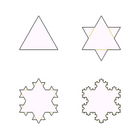
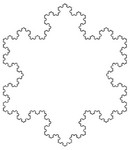
<p>Mathematics had many such unusual geometric figures, which predated Mandelbrot&#8217;s discovery of fractals. For example, in a 1904 paper, the Swedish mathematician Helge von Koch presented what has come to be known as the Koch snowflake. Take an equilateral triangle (i.e., each side is the same size. Then divide each side into thirds and on the middle third build another equilateral triangle. Continue this process with those triangles, and with all subsequent triangles. The figure on the left below shows this process progressing through four stages. The figure on the right shows the result after eight stages.<br /></p>

<p><img src="http://www.dharmacafe.com/images/uploads/KochFlake-1-4_thumb.png" alt="image" width="180" height="180" />&nbsp;  <img src="http://www.dharmacafe.com/images/uploads/Koch-snowflake-8_thumb.jpg" alt="image" width="156" height="180" /><br /><br /><br /><br /><br /><br /><br /><br /><br /><br /><br /><br /></p>

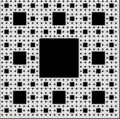
<p>A closely related figure is the Sierpinski triangle, described by mathematician Waclaw Sierpinski in 1916. In this case, take another equilateral triangle, but this time, divide it into 4 equilateral triangles and remove the middle one. Continue this process with all the triangles that emerges. Or instead of a triangle, take a square, divide it into smaller squares and remove the middle ones. Again the process continues. The process can be used just as readily on 3-dimensional objects or even higher dimensional objects, though of course we can no longer see what those look like. The most famous of the 3- dimensional objects is the Sierpinski cube. Here are pictures of the Sierpinski triangle, square, and cube. </p><p><br /></p>

<p><br> <img src="http://www.dharmacafe.com/images/uploads/sierpinski-triangle_thumb.gif" alt="image" width="120" height="120" />&nbsp; <img src="http://www.dharmacafe.com/images/uploads/sierpinskicarpet2_thumb.gif" alt="image" width="120" height="119" /><img src="http://www.dharmacafe.com/images/uploads/sierpinskicube027_thumb.gif" alt="image" width="120" height="120" />&nbsp;  &nbsp;  &nbsp;  &nbsp; <br />
<br /><br /><br /><br /><br /><br /><br /><br /></p>

<p>Until Mandelbrot, however, these strange figures were considered anomalous, or even &#8220;pathological.&#8221; Mandelbrot broke the ice with a three page paper that somehow slipped into the illustrious (and usually staid) pages of <i>Science</i> in 1967, called &#8220;How long is the coast of Britain?&#8221;<sup>2</sup> This paper has become known not only to mathematicians, but to the general public as well, usually for the wrong reason. Reference books often give figures for the length of the coast line of various countries. But it&#8217;s self-evident that the length depends on the measuring device. If a ruler is used instead of a yardstick, the coast line will be much longer, because the yard stick can measure smaller differences in its shape. If we let the unit of measure get smaller and smaller, ultimately the length of any coast would <br />
be infinite. That&#8217;s what most people think Mandelbrot&#8217;s paper was about. </p>

<p>Actually he had discovered something quite different. He had come across a 1961 paper by Lewis Fry Richardson, who Mandelbrot later referred to as &#8220;a great scientist whose originality mixed with eccentricity.&#8221;<sup>3</sup> Richardson had found that the approximate length of a variety of actual coast lines could be calculated by a simple formula into which you plugged the length of measurement you were using. The formula had a constant &#8220;D&#8221; that varied by the coast line.<sup>4</sup> So for the coast line of Spain, there <br />
was one &#8220;D&#8221;, and another for &#8220;Britain,&#8221; and so forth. This was exactly what Mandelbrot meant by fractal (though he hadn&#8217;t yet come up with the word yet). Mandelbrot&#8217;s breakthrough was to recognize that this constant &#8220;D&#8221; was actually a dimension, even though it wasn&#8217;t a whole number. In other words, in addition to the 1-dimension of a straight line, the 2-dimensions of drawings on a plane, the 3-dimensions of solid objects, etc., he was proposing that there could be fractional dimensions. For example, in the paper, heproposes that the dimension of the west coast of Britain is approximately 1.25. </p>

<p>We needn&#8217;t be concerned with the math here. What is significant is that the math produced figures which were self-similar no matter what level you looked at them. By 1973, Mandelbrot was working for IBM as a fellow at the Thomas J. Watson research center, and had access to high-speed computers. This was like a Disneyland for Mandelbrot. He worked out formulas which, when fed back into themselves over and over (as with everything else in chaos theory), produced coast lines that actually looked like real coast lines. Mandelbrot went on to generate clouds and trees and rivers and almost anything else imaginable in nature. The implication was that, since he could generate something that looked remarkably like a natural phenomena by building it up out of little self-similar pieces, then nature itself might use the same technique. Nature might be fractal. Or, as the Emerald Tablet had it: &#8220;as above, so below.&#8221; </p>

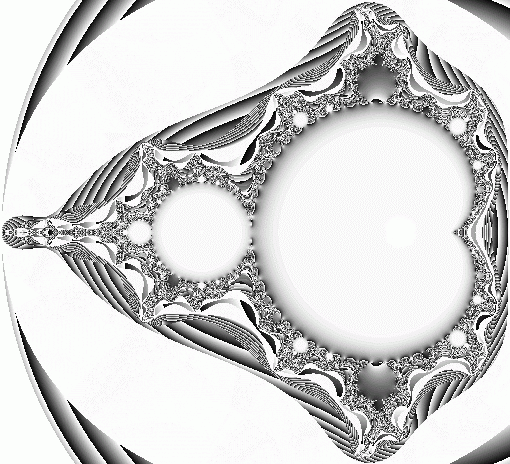
<p>The most famous of all fractal creations is the Mandelbrot set, which is the most complex mathematical object in existence. As with all the earlier fractals, it&#8217;s generated from a very simple formula<sup>5</sup> with the results fed back over and over again. It&#8217;s normally generated using colors to show distinctions, but a beautiful black and white version follows, created by mathematician Ed Pegg, Jr. The shadings in color between black and white were generated by the average differences between iterations.</p>

<p><img src="http://www.dharmacafe.com/images/uploads/MandelbrotDistances-bw.gif" alt="image" width="510" height="464" /></p>

<p></br></p>

<p>Again imagine that you had an enormously powerful microscope which you could use to look at <br />
any part of this figure. If you would do so, you&#8217;d find that what you saw would look remarkably like the <br />
whole picture you&#8217;re seeing. What makes this more interesting than the fractal objects you&#8217;ve seen earlier <br />
in this chapter is that you would find creative differences between the original figure and its copies at <br />
each deeper level. These approximations to the original look very similar, but each has variations of its <br />
own, as if some celestial artist kept working with it at every level. The new insight that chaos theory and <br />
fractals give on the ancient idea of &#8220;as above, so below&#8221; is that there may be beautiful variations on <br />
theme that emerge without any way of predicting what they will be.</p>

<p>Notes:<br />
1. Asimov, Isaac, I, Asimov: <i>A Memoir</i>, New York, Bantam, 1995. Quoted in Clifford A. <br />
Pickover, A Passion for Mathematics. (Hoboken, New Jersey: John Wiley &amp; Sons, 2005), p. 90. <br />
2. Mandelbrot, Benoit, &#8220;How long is the coast of Britain?&#8221;. <i>Science 156</i>, pp. 636-638. <br />
3. Mandelbrot, Benoit. T<i>he Fractal Geometry of Natur</i>e. (New York: W. H. Freeman &amp; Co., <br />
1977), p. 29. <br />
4. The actual formula was L(&#128;) 	&#732; F&#128;<sup>1-D</sup>. <br />
5. Z<sub>n+1</sub>=Z<sub>n+c</sub>, where c is a complex number; that is, a number with both a real and an imaginary <br />
component. </p>

<p>
</p>
      ]]></content>
    </entry>

    <entry>
      <title>Lessons from Alchemy &amp;amp; Chaos Theory</title>
      <link rel="alternate" type="text/html" href="https://dharmacafe.com/nature-psyche/lessons-from-alchemy-chaos-theory/" />
      <id>tag:dharmacafe.com,2007:nature-psyche/15.599</id>
      <published>2007-10-06T20:10:00Z</published>
      <updated>2007-10-16T22:53:58Z</updated>
      <author>
            <name>Bill Stranger</name>
            <email>comments@christinesuzuki.com</email>
                  </author>

      <content type="html"><![CDATA[
        <p><b>DharmaCafe is pleased to present the first in a series of articles connecting the traditional and ancient science of alchemy to the new science of chaos theory written by mathematician, practicing Jungian psychologist, and life-long amateur magician Robin Robertson. Here Dr. Robertson overviews the entire series and introduces several fundamental alchemical principles.</b>
</p> <blockquote><p><b><big>Introduction:</big></b></p>

<p>	How is it that transformation comes about? Let us look at two models of that process, both of which ostensibly look at outer transformation, while unknowingly also speaking about inner transformation. One is an ancient model - Western alchemy - which came into existence in the Western World during the 1st through the 3rd centuries,&nbsp; reached its peak in the 15th and 16th centuries, and still existed in some form during the 17th and 18th centuries. It was only in the twentieth century, however, that the idea first occurred that alchemy was actually a model for psychological transformation. Psychologist C. G. Jung argued that the alchemical <i>opus</i> (i.e., the stages of the process leading to the production of the Philosopher&#8217;s Stone), was equally a portrait of the stages of the individuation process of the alchemists, which they were unconsciously projecting out onto the physical world. Religious historian and philosopher Mircea Eliade placed the emphasis slightly differently: he said that the processes that underlie alchemy lie deep in both the psyche and the world, and must then inevitably occur in any transformative process, whether in chemical beakers, or inside the human soul.</p>

<p>	The other model - chaos theory - is much more recent. Deterministic chaos was first recognized explicitly in the early 1960&#8217;s, with meteorologist Edward Lorenz&#8217;s early computer models of weather. His work led to what has been termed &#8220;sensitive dependence on initial conditions.&#8221; Or more popularly - <i>the butterfly effect</i> - the idea that the flutter of a butterfly&#8217;s wings in China might affect the weather in Los Angeles. This is because very tiny initial changes can have very large final effects, when the changes are fed-back into a system and amplified,&nbsp; over and over.</p>

<p>	Anyone who is called to the difficult inner journey of self-transformation ineluctably awakens deep structures in the psyche that can be seen in both the alchemical opus and, properly translated, in chaos theory. These two parallel models share five critical insights (as well as many smaller ones) which provide a template for transformation. No matter what particular spiritual path we have chosen (or which has chosen us), these insights can help enrich our understanding of the process of transformation, whether outside in the world, or within our own lives.</p>

<p><b>1. The self-referential nature of reality</b><sup>1</sup><br />
In alchemy, this is represented in the core belief of &#8220;as above, so below,&#8221; first presented in the fabled &#8216;Emerald Tablet.&#8217; In Chaos theory, this occurs in several different presentations, including the fact that global (i.e., as above), and local (so below) are inextricably mixed. The chaos theory example which is equivalent in renown to the Emerald Tablet might, however, be Benoit Mandelbrot&#8217;s mathematical concept of fractals.</p>

<p><b>2. Feedback <br />
</b>Here I&#8217;m using the more modern term. All of chaos theory is based on feeding back information from one stage of a process to the next stage of the process. The computer has allowed scientists, for the first time, to model the way nature continually feeds back actions into themselves. But alchemy tried earlier to model such behavior by building up-and-down movements into their alchemical stages such as <i>sublimatio</i> (sublimation, aeration, rising, spirituality), and <i>mortificatio</i> (mortifying, falling into matter), or more explicitly in the <i>circulatio</i> (continual cycles of rising and falling). But the most ancient alchemical symbol of feedback is the image of the <i>uroboros</i>, the snake that swallows its own tail.</p>

<p><b>3. Transformation through cycles of taking apart and putting back together<br />
</b>In alchemy, this is accomplished through stages such as <i>solutio</i> (i.e.,dissolve), and <i>separatio</i> (break into parts), followed by stages such as <i>coagulatio</i> (coagulate, come together) or coniunctio (conjunction, joining). This process is implicit in all of chaos theory, especially in &#8216;strange attractors.&#8217; The most famous example is the <i>baker transformation</i>, in which a baker kneads dough over and over, separating parts of the dough that are close together, and bringing together other parts that were widely apart.</p>

<p><b>5. Chaos/Emergence<br />
</b>In alchemy there was an explicit stage of darkness and confusion: the <i>nigredo</i>. There was an understanding that because this chaos was beyond all definition, it implicitly contained all possibilities within itself. Eventually, points of light (<i>scintillae of light</i>) would begin to emerge within the darkness of the alchemical experiment. There was no possibility of predicting which spark would suddenly grow into the light of new birth, but new birth there would be. </p>

<p>	And, of course, as one can tell by the name chaos theory, chaos is explicit part of the modern model. As we will see in more detail, order gradually <i>bifurcates</i>, splitting into first two possibilities, then four, and so on. It is impossible in advance to predict which fork will be taken. Then at some further point, the bifurcations change into chaos. But what is a new insight in chaos theory, is that even this chaos has structure at a global level, that out of it emerges a new order.</p>

<p><b>6. Inseparability of Experiment and Experimenter<br />
</b>There are innumerable references in alchemical texts to the idea that in order to fully carry out the opus, the alchemist must first purify himself in order to become worthy of the <i>stone</i>. Though less explicit in chaos theory, it is nevertheless found there. For example, neurobiologist Walter J. Freeman, a pioneer in the application of chaos theory within neuroscience, discovered that: &#8220;Instead of minds shaping themselves to their sensory inputs from the world, minds shape sense impressions according to their innate categories.&#8221; Freeman demonstrated this conclusively through his study of dynamic attractors in the brain for odor and other senses.</p>

<p>	This last topic - the inseparability of experiment and experimenter is, of course, why alchemy and chaos theory can teach each of us something about our own process of self-transformation. This conjoined relationship between the world and the psyche was perhaps best expressed in the words of Alain de Lille, 12th century theologian: &#8220;God is an intelligible sphere whose centre is everywhere and whose circumference is nowhere.&#8221;<sup>2</sup> Each of us through our own process of growth and transformation in turn affects everyone and everything.</p>

<p>{pagebreak}</p>

<p><b><big>Lesson 1a from Alchemy: As Above, So Below</big> <br />
</b>
</p><blockquote><p>Tis true without lying, certain &amp; most true. That which is below is like that which is above &amp; that <br />
which is above is like that which is below to do the miracles of one only thing. And as all things <br />
have been &amp; arose from one by the meditation of one: so all things have their birth from this one <br />
thing by adaptation. <br />
- From Isaac Newton&#8217;s translation of the <i>Emerald Tablet</i>.</p></blockquote><p> </p>

<p>The idea that the <i>macrocosm</i> (the universe or God) and the microcosm (the physical world, a <br />
human being) are inherently connected is the first crucial element of alchemy that we will study. The <br />
equivalent understanding in chaos theory is that reality is self-referential at every level. We will deal with <br />
alchemy in this lesson, then its equivalence in chaos theory in the next. </p>

<p>Perhaps the single most important core belief of alchemy is contained in the phrase &#8220;as above, so <br />
below,&#8221; which first appeared in the fabled Emerald Tablet, also known as the Smaragdine Table or the <br />
Tabula Smaragdin. Though the earliest documented source for the <i>Emerald Tablet</i> itself is an 8th century <br />
pseudo-Aristotelian Arabic text, which was translated into Latin in both the 12th and 13th century, it is <br />
likely, however, that it evolved from earlier documents and may well have its origin in more primitive <br />
versions that go back to the period just before the start of the Christian era &#8220;when the thought models of <br />
the Greek philosophy met with the experimental practices of the Egyptian traditions.&#8221;<sup>3</sup></p>

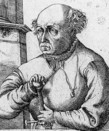
<p><b>Paracelsus</b> </p>

<p>The mysteries of the Great and the Little World are distinguished only by the form in which they<br />
manifest themselves; for they are only one thing, one being. <br />
- Paracelsus.<sup></p><p></4></p><p> </p></blockquote>

<p><img src="http://www.dharmacafe.com/images/uploads/Paracelsus_thumb.jpg" alt="image" width="109" height="131" />We are now going to jump forward to the 16th century, when <br />
alchemy reached its peak. One of its most influential expositors was physician Philippus Aureolus Bombast von Hohenheim, more commonly known as Theophrastus Paracelsus, or simply Paracelsus [1493&#8211;1541]. Paracelsus was born the illegitimate son of a wandering doctor who settled in the small Swiss town of Einsiedeln. As a young man, he was hardly physically prepossessing, with &#8220;a stature of a mere five feet, an unhealthy appearance, an upper lip that was too short and did not quite cover his teeth . . . and, so it seems, a pelvis that struck everybody by its femininity.&#8221;<sup>5</sup> Despite that appearance, or perhaps because of it, he strutted around life with an arrogance that earned him many enemies, especially among his fellow physicians, whose methods he reviled. </p>

<p>He was a physician, an alchemist, an astrologer, an occultist, and one of the Renaissance&#8217;s most prolific authors. While still in his teens, he studied medicine at the University of Basel. On the move as always, he then went first to Vienna and later gained his doctorate degree from the University of Ferrara in Italy. Unsatisfied by the methods he learned at the Western universities, he continued his traveling ways, through Egypt, Arabia, the Holy Land, Constantinople, Lisbon, Spain, and England, always looking for newer methods, methods that fit in with his holistic view of reality. </p>

<p>The Renaissance was a time when thinkers turned their eyes onto the physical world around them and began to observe and measure it carefully in a way that few had done earlier. They looked both above and below: outwards toward the heavens and down onto the earth they lived on. Paracelsus was interested less in one or the other of the two worlds than in the Hermetic doctrine that the two were necessarily connected. In Paracelsus&#8217; words: &#8220;Heaven is man, and man is heaven, and all men together are one heaven, and heaven is nothing but one man.<sup>6</sup> This lovely phrase means not only &#8220;as above, so below,&#8221; but also &#8220;as below, so above,&#8221; which we will see fits closely with chaos theory. He believed that each of us was composed of an earthly part and a heavenly part, or as he said &#8220;Man is the child of two fathers - one father is the earth, the other is heaven . . . . From the earth he receives the material body, from heaven his character.&#8221; Thus our characters were, as all believers in astrology argue, determined at the moment of birth by the total form of the heavens. That also meant, in his view, that each of us carried a particular heaven with us at all times. And further, that the heavens above were composed of all these individual heavens. Unlike most astrologers, Paracelsus insisted, however, that: &#8220;It is not true that the firmament exerts a compelling action upon man; on the contrary man himself acts upon the world more than he is influenced by it.&#8221;<sup>7</sup> </p>

<p>When Paracelsus returned to Europe, his medical treatments went completely against the grain of most of his colleagues. Just as he believed that the heavens determine our character and the earth our physical being, he also believed that there is a wholeness to our body and character that is reflected at all levels. The central concept of his treatments was that &#8220;like cures like.&#8221; This breakthrough concept led physicians for the first time to use chemical treatments for diseases. As such it is the foundation for all  modern medicine. In his treatments, he used arsenic, mercury, sulfur, iron, copper sulfate and other metals. His idea of like curing like is also the basis for the more controversial modern method of &#8220;cell therapy,&#8221; where cells are taken from an organ of the body, then injected into the body to cure the damaged organ. </p>

<p>But Paracelsus felt that these methods, powerful as they were, could only be effective it the physician approached the patients with compassion and even love, because it was love that could bridge the seemingly inseparable distances between human beings. &#8220;First of all it is very necessary to tell of the compassion that must be innate in a physician.&#8221; &#8220;Where there is no love, there is no art.&#8221; &#8220;The practice of this art lies in the heart: if your heart is false, the physician within you will be false.&#8221; For again, within each of us lay a piece of heaven, and through that heaven, each could be joined to the other. In our next lesson, we will look at the equivalent insights from chaos theory.</p>

<p>Notes:<br />
1. These five processes will be individually explored in later articles in this series.<br />
2. This idea was thought to have originated in the Corpus Hermeticum of the 3rd Century. It later found many variant expressions in authors as famous as Pascal and Emerson.<br />
3.. von Franz, Marie-Louise. Alchemy: an Introduction to the Symbolism and the Psychology (Toronto: Inner City books, 1980), p. 11. <br />
4. quotation from Jacobi,Jolande. Paracelsus: Selected Writings (Princeton: Princeton University Press, Bollingen Series XXVIII), p. 19. <br />
5. Jung, C. G. &#8220;Paracelsus,&#8221; in Collected Works, Vol 15: the Spirit in Man, Art, and Literature (Princeton: Bollingen Series, Princeton University Press, 1942),&nbsp; par. 6. <br />
6. quotation in Jacobi, Paracelsus: Selected Writings, p. 39. <br />
7. quotation in Jacobi, Paracelsus: Selected Writings, p. 153.</p>

<p>&nbsp;</p>

<p>&nbsp;</p>
      ]]></content>
    </entry>


</feed>