Is it possible for anything to be totally unintelligible, completely nonsensical, so out in left field that nobody can make any sense of it at all? The answer must be affirmative, if by unintelligible we mean that which we cannot effectively tell, that which we are incapable of putting into words.
With respect to the nature of understanding, for example, we might take the view that what cannot be understood is that which has no other. This notion of other is taken in two ways, and each way ushers in its own particular problem. The first problem is this: to understand something there must be at least something else against which that something can be compared and contrasted, against which there can be some standard of judgment, and, if there is no other something, then there is no yardstick by means of which to judge the first something. The second, considerably more cantankerous, problem has to do with language: to make something intelligible in words implies that there is in the very least words in addition to that something that is to be put into words, and that some sort of correspondence can be had between words and that something. Without words, the something must remain unintelligible. Without words, there’s not much of worth to be known——this, at least, is the customary time-honored view.
Yes, words. Proud words, bearers of all that is worth knowing. They are signs that link up to that with which they are interdependently, interrelatedly, interactive by way of cultural conventions. The problem is that during the past century, words became the spoiled offspring of more basic nonverbal signs. After the so-called ‘linguistic turn’ in the humanities and social sciences, we have come to consider language not merely the culmination of human expression, but the heart and soul of all thought and communication. Language now predominates to the extent that we take virtually all signs of sight, sound, smell, taste, and tactile sensations basically in terms of language, language as mediator and revelator of concrete experience. Sensations must pass through the language filter before they can become adequately understood. And mind is the grand adjudicator deriving understanding from language. Mind is the knower of what is to be known, and body, processor of sensations conveyed to mind, is no more than at best a willing servant. Consequently we tend rather contemptfully to relegate the more basic semiotic forms of communication directly emerging out of concrete sensations received by body to the category of relative unimportance, or we attempt conveniently to ignore them, while rendering homage to mind.
It is quite comfortable to assume that if something is intelligible it must require language, and that by and large European languages are chiefly dualist——bivalent——in nature, following traditional logical tenets. This puts everything into neat sets of pigeon-holes. But what if reality is fundamentally nondualistic? What if certain aspects of the world resist either/or imperatives? What if the world itself is of contradictory, inconsistent nature? In such case, the world must be made unintelligible, according to the imperatives of classical logic. We might tend to rebel against the very thought. We want crisp, clear-cut words and meanings. In order that reality may be made intelligible, for every concept or word there needs be something against which it stands. Here the word, there the thing. Here the word, there the maker or taker of the word. Here the word, there the meaning. Quite comfortable, all this.
The Christian edifice also enjoys its root beginning with the dualism of good and evil. After all, Christianity——along with Greek philosophy, which is also injected with a massive dose of bivalency——is where much of Western thought begins. Everything else emerges from there. Adam and Eve knew neither happiness nor sadness, neither joy nor sorrow, neither pleasure nor pain, until they partook of the fruit of the tree of knowledge, of good and evil. And, of course, it had to be a slithering, formless, nonbinary and unstructured serpent that was instrumental in bringing about this original sin.
Unintelligibility can be considerably less mundane than metaphysical thought and ancient religious accounts. Concepts that incorporate falsehoods as if they were true may actually be unintelligible. The ancient notion that the earth rests on an elephant’s back and the elephant is standing on a turtle’s back is in a manner of speaking unintelligible. It is so unintelligible that we tend to take it as simply child-like. Do the elephant and turtle live forever? Where did two beasts of such magnitude come from? And most perplexing of all, if the elephant stands on the turtle, then what does the turtle stand on? When the story of the earth, the elephant, and the turtle was narrated by a Buddhist monk and he was asked this last question, he is reported to have responded: ‘It’s turtles all the way down.’ The response is in a manner of speaking also unintelligible, because the idea of infinity is implied, and an actual infinity of existent objects is inconceivable.
But, then, one may wish to retort that the elephant-turtle account is mere myth, and should not really be taken seriously. Actually, this account is of mytho-scientific origin; it stems from an attempt to describe and explain the universe. Surprising as it may seem, concepts that incorporate apparent falsehoods as if they were true are also found in many scientific theories, and some of them have even come to be taken as unintelligible. As an example, allowed me to put a certain aspect of quantum theory in a nutshell, if you will, since here, we have an account that could well be for generations of the distant future considered mytho-scientific as well. Is the wave interpretation or the particle interpretation most appropriate for the quantum world? This posed a virtually irresolvable problem for almost two decades. Then Niels Bohr suggested that quantum events can be conceived as either waves or particles, depending on the context. But the catch is that they cannot be waves and particles at the same instant. In the classical, atemporal sense, then, it can be said that quantum events are both of wave and particle nature, or that they are neither of wave nor of particle nature. This quandary remains, at least for classical thinking. The term ‘wavicles’ was proposed for quantum events, but that doesn’t quite cut the cake. It only gives the quandary a convenient label.
John von Neumann developed an alternative logic, ‘quantum logic’, in an attempt to account for the strange world of quanta. Basically, quantum logic does away with the classical Excluded-Middle Principle, though it still holds true to the Principle of Non-Contradiction. If we embrace quantum logic, then classical logic loses face (Heelan 1970, 1971, Putnam 1969, 1971). So we must toss binary values as we know them in the trash can, for nothing would necessarily be true or false, good or bad; rather, some act of mind would be sufficient to make it so. How could this possibly occur? Would not the consequences be devastating for our Western cultural life as we know it? How could we begin to cope in a world the very ground of which has been ripped from underneath us?
Perhaps the problem is not as dire as we might expect, however.
Where our dualism got us
In classical logic, two statements each of which is presented as true, yet they contradict each other, are considered inconsistent. Falsified scientific theories have been so falsified because contradictory statements that were incorporated within the same theory were revealed, and the theory was thereby disproved.
{pagebreak}
We find an example of this in Newtonian mechanics. It held the reins of scientific knowledge for about two and a half centuries. Classical physics was a success story the likes of which have occurred few times in human history, if at all. However, a thorn in the side of Newtonian mechanics remained in the form of Mercury’s perihelion. The planet should move in smooth ellipses like the other planets. But it didn’t. It wobbled slightly, creating an unbalancing effect. Thus predictions regarding Mercury’s behavior were less than satisfactorily accurate. And science was stuck with a contradiction. Einstein’s relativity seemed to resolve the issue. At least it resolved this particular issue. But others quandaries remained. For instance, within Einstein’s universe we have the ‘twin paradox.’ One of the twins enjoys a trip around the universe at a velocity approaching the speed of light, while the other twin stays home. When the adventurer returns, many years have transpired on Earth, but as far as she is concerned, her trip lasted only a few weeks. She has aged little, but to her consternation, her sister is now old and infirm. So to the question ‘Can our scientific theories be entirely free of contradictions and hence inconsistencies?’ an ultimate answer can hardly be forthcoming, at least in terms of classical logical terms.
Aristotle is often considered the father of classical logic. Aristotle set out the Identity Principle according to which something is what it is and nothing else, for if it were something else it would not be what it is, hence nothing else can be what that something is either. The Principle of Non-Contradiction is dependent upon the Identity Principle. It says that if something is what it is, then it cannot be anything else. Then there is the Principle of the Excluded-Middle according to which if A is what it is and nothing else, then whatever there is must be A, or it must be Not-A, and there can’t be anything else. There can be no third option between something and that which it isn’t. In a nutshell, that’s about it. Rather disappointing, one might think. Nevertheless, it guided much Western thought for a little over a couple of millennia.
Actually, the condition of classical logic is not as severe as it might appear. When we look at the fine points, we come to understand that A cannot be Not-A at the same time and in the same respect. This greases the wheel a little so it can move in one direction or the other and even make a few wide turns when it must in order to avoid catastrophe. It confines the Principles of Identity and Non-Contradiction to legitimate identities and contradictions and excludes the apparent ones. There is no identity, contradiction, falsity, or unintelligibility in a statement about something that holds at one time and place and in one respect but not at another time and place. To say ‘All people are mortal’ is apparently unquestionable. To say ‘The earth rests on an elephant’s back’ might appear patently absurd, and perhaps even unintelligible for today’s worldly inhabitants. Yet according to certain accounts it was found acceptable by a certain group of people from a past culture. The idea that ‘The universe is (like a) a machine’ predominated Western scientific thinking for a few centuries and came to pervade its general mind-set for generation after generation. Today, however, it has by and large fallen from grace——though there are some well-meaning citizens of the world who apparently don’t know it yet. A sentence is considered contradictory in the strict logical sense only in the event that it is simultaneously subject to affirmation and negation. In such case it is inconsistent, and one might wish to say, unintelligible——though children, poets, and mystics would likely disagree on this point.
In this sense ‘A and not Not-A’ might appear as the sole survivor with respect to iron-clad contradictory sentences. Even such apparently deductive sentences as ‘1 + 1 = 2’ and ‘All people are mortal’ are not absolutely immune to revision under certain circumstances (philosopher Charles S. Peirce himself has said as much). In quantum theory the addition of certain subnuclear particles does not yield a product equal to ordinary arithmetic addition. Rather, it leaves us with less of what we started with. In this manner we might conjecture that we have the equivalent of ‘1 + 1 = 1’. In Boolean logic also, as well as Spencer-Brown’s (1979) ‘Laws of Forms’, if an annotation is made, and then made again, it is the same as if it were made once. Hence also ‘1 + 1 = 1’. Disconcerting.
Even more disconcerting, in quantum theory and relativity, enigmatic numbers called ‘imaginary numbers’ (or √√-1) occasionally pop up. How can we rationalize these numbers? If we say ‘*√-1 = +1’, it’s a strike against us. If we say ‘*√-1 = -1’, we’re victims of another strike. One more strike and we’re out. What are we to do? Say the answer’s both of the possibilities, and it’s neither of the possibilities, which leaves us with a paradoxical situation? There seems to be no rational answer to the problem. Nonetheless, scientists and computer engineers customarily use ‘imaginary numbers’ in their mathematical description of what is presumably ‘real’. Biologist and physicist Howard H. Pattee (1969, 1972, 1979, 1986) goes so far as to speculate that the equivalent of ‘imaginary numbers’ exists at the heart of life processes.
In our age when prosthesis, transplants, and cloning are coming into their own, who knows how and to what extent life can be prolonged a century from now——if by that time we haven’t all destroyed ourselves and our planet Earth to boot. With respect to presumably inductive truths, the sentence ‘All crows are black’ is not absolutely fool proof. We can have no absolute proof, inductively speaking that is, until we have observed each and every crow, past, present, and future, which is to say that we have to be well nigh immortal, thus refuting the deductively or synthetically derived sentence ‘All people are mortal’.
Pouring more salt in our inductive wounds, Carl Hempel’s once demonstrated that in order to obtain absolute proof that ‘All crows are black’, we have to confirm the contrapositive sentence, ‘All nonblack things are noncrows’. This for sure lands us in interminable task. After all, if we spot a nonblack thing, how do we know it is not a crow until we have verified its noncrowness? For all we know it could be an orange crow we overlooked when we were obsessed with our premise that ‘All crows are black’ and we overlook that white thing that happened to be a bird that happened to be a crow. One could perhaps say that by deduction we can try our damnedest to demonstrate that a sentence is not inconsistent, and that by induction we can try our damnedest to demonstrate that a sentence is not consistent, and in both cases we will either end up with an inconsistency, or our search will suffer from incompleteness, given our finite capacities.
The inconsistency or incompleteness of all sufficiently sophisticated formal systems is due to the enterprising work of mathematical logician Kurt Göödel (Nagel and Newman 1964). His two incompleteness theorems reveal the impossibility of our deciding on the truth of a logical system from within that selfsame system. Some scholars have suggested basically the same with respect to ordinary language use, and indeed, with respect to all sign making and taking. The layperson’s example of Göödelian undecidability is a variation of the infamous Cretan paradox in the form of ‘This sentence is not true’. Is it true or is it false? If we say it’s true, then it says of itself that it is not true, so it is false. O.K. So we assume it is false. But that is what it says of itself anyway, so what it says of itself is true, so it is true. We simply can’t win. The sentence refers to itself, it contradicts itself in its self-reference, and thus it sets up an infinite regress. We might wish to say that the Cretan sentence is not true and false simultaneously. We read the sentence, pretty much like we read most sentences, by charitably suspending disbelief and giving it its say. Then, after the fact, we think about what it says of itself, and we balk. Why, the sentence is absurd, nonsensical, and perhaps unintelligible! And we are in a certain sense correct: the sentence actually doesn’t affirm and deny itself in the same breath, in the same instant.
{pagebreak}
Willard V. O. Quine (1969) points out that in natural language we can get closest to a Göödelian undecidable sentence with something I have simplified for the sake of the present argument as: ‘‘Is an inconsistent sentence’ is an inconsistent sentence’. The phrase inside the inner quotes is a mirror image of the sentence outside the inner quotes; the first phrase acts as the subject half of the sentence and the second phrase is the predicate half. The problem is that subject and predicate are identical. Now we might say that time enters the picture once again. We read the first phrase. Then, upon reading the same phrase again, our sense of the first phrase undergoes an alteration. Gertrude Stein’s ‘A rose is a rose is a rose’ suggests that it is not only a matter of a rose by some other name being either different or the same. It is also a matter of time. Saying ‘A rose’ and then saying it again alters the context of the first saying and the second saying and it alters the combination of both sayings such that meaning is also altered.
This might all appear fine and dandy. However, the previous couple of paragraphs deal chiefly with logically formulated sentences and genuine paradoxes. What we usually tend to call contradictions are only pseudo-contradictions. For example, assume Charlton Heston, once President of the National Rifle Association, were to declare, ‘The question of our right to bear arms is not negotiable’. Then he is asked: ‘Do you mean to say, Sir, that you are absolutely unwilling to discuss the issue?’ To this he replies: ‘Of course not. I will discuss the issue until I am blue in the face. The fact remains, however, that our right to bear arms is not negotiable’. Then: ‘But with all due respect, are you not contradicting yourself?’ The disgruntled reply: ‘It seems a contradiction, but it is not. I cannot refuse an offer to discuss this problem, but my mind is settled on the topic’.
Marxist intellectuals often adopt some version of Hegel’s view according to which the Principle of Non-Contradiction is not valid. Yet they do not in fact accept two statements that contradict each other as both true in all respects. In a well-known essay, Mao Ze-Dong distinguished two types of contradictions. There are contradictions that exist among the people———right-minded comrades, that is. These are benign contradictions, and hence ‘nonantagonistic’. There are also contradictions between what the people believe and what the enemy believes. These are malignant, antagonistic contradictions, and must be eradicated at all cost, even by disappearing the enemy if there is no other way. Neither type of contradiction is considered inconsistent with the Principle of Non-Contradiction. On the contrary. In either case, two contradictory positions cannot both be true. Ultimately, there must be a choice of either one pole or the other of the contradictory premises. As far as Mao is concerned, both types of contradictions must be solved. The difference is that one type must be solved by war, and the other type can perhaps be solved by going to the discussion table (in Schurmann 1968: 55).
Where is all this taking us anyway? What does it have to do with our learning from life, from living? The implication of this section, I would suggest, has a bearing on traditional notions of reasonable and logical knowing and how it is that we can acquire this knowing.
Whose logic?, What kind of logic?
To begin, if we are not content with what conventionally goes as rational argumentation, then why should we flee from whatever our convention tells us is contradictory with the fear that if we do not free ourselves of the contradiction we will surely remain in the dark back alley of ignorance? Yet, should we not reject as irrational any body of knowledge that can rest content with a few contradictions lying around here and there?
If one’s knowledge can include contradictions, then is not the whole of that body of knowledge flawed? Is it perhaps not even nonsensical and virtually unintelligible? On the other hand, if we are satisfied with nothing less than clear and distinct, and consistent and complete, accounts of the world and ourselves and of our knowledge of those accounts, will we not ultimately become like Buridan’s proverbial ass that, suffering from hunger and thirst, couldn’t decide whether to turn left to the water or right to the food that was offered him, and finally dropped dead right there in the same spot? Will we be able to decide at all? Will we not eventually suffer from cognitive combustion and burn out?
Our Eurocentric prejudice has customarily had it that the West is rational, while many other cultures engage in mushy, irrational thinking, and somewhat childish behavior. Actually, if we toss Western biases to the winds and look at the West and the rest somewhat more dispassionately, we find a complex situation. The West, it is now well known, does not have a monopoly on science, even Western science. Joseph Needham’s massive Science and Civilization in China (1954) was one of the first thoroughgoing studies to address this problem. It is becoming increasingly evident that the West is split between what is considered the rational tradition, mathematics and science, and the irrational tradition, that is, the tradition based on faith rather than reason, culture-laden ethics rather than logic, and gratuitous aesthetics rather than purposeful rhetoric. Take religion, for example. Witness the controversy surrounding feminist movements, abortion, prayer in the schools, gay and lesbian rights, Aids and stem-cell research, and especially, evolutionary theory and creationism. There is in the Christian West a season and an irreason for all things. Maintain a critical and even skeptical demeanor during the week, but be sure you are willing to espouse the most irrational brand of blind faith in the incomprehensible on Sunday, at least while in church.
Westerners tend to approach Eastern philosophy as a religion, hence more often than not the assumption has it that they are dealing with blind faith and irrationality. However, this comfortable notion by means of which we can decry the East and revel in our science and technology is the other side of the Eastern coin, which enables them to critique Western materialism and consumerism. The West takes reason as the way to go about life in the physical world and leave subjective, intuitive, contemplative concerns to the spirit. The East cannot steer clear of subjective, intuitive, contemplative concerns, and embraces them along with spiritual life and everyday life in the physical world of joy and pain and pushes and pulls. Which is to say that the East maintains a critical, rational posture regarding everyday as well as religious life, while the West tends to maintain a shrift between the two, relegating religious to the irrational while coveting objective, empirical, and rational life to the maximum. In this sense at least, one can justifiably assert that the West is irrational, as a result of the split, while he East wishes to exercise rationalism with respect to unified life’s experiences.
What are the implications of the West’s chasm between religion and faith on the one hand and science and reason on the other with respect to the East’s union of everyday affairs with religious affairs? They are far-reaching. The West has generally confined reason to the study of the natural sciences and the human sciences, with the assumption that the two areas of scientific endeavor belong to distinct modes of theory making and methods of research———although that assumption has changed in some circles since the turn of the last century. To a limited degree, scientific concerns were at times extended into philosophy, especially during the heyday of logical positivism. But the applications were severely restricted, and so it did not much benefit the humanities at large. The human soul was considered the subject of religion, in that hazy area where irrationalism and faith rather than tough-minded reason and hard evidence were embraced without qualms. The sciences did not touch a person’s soul or the subjective side of her mind, and when they made the attempt, more often than not they used a ‘pseudo-positivistic’ methodology resulting from an impoverished notion of what the natural sciences were imagined to do.
The idea that linguistics is an area of rational investigation, for example, is a relatively recent discovery in Western civilization. The concept was pioneered by Ferdinand de Saussure and brought to a screaming pitch with Noam Chomsky’s transformational and generative grammar. Linguistics as a positivist or rational area of inquiry, however, has seen its better days. In fact, over the past three decades the study of languages has been in the process of taking a softer ‘cultural-political turn’, as witnessed explicitly through George Lakoff’s studies (for example, 1987, 2004, Lakoff and Johnson 1980), and implicitly in Chomsky’s seething critiques of U.S. policies (for example, 1988, 2002, 2006).
The notion that religion and mysticism can and should be explored rationally has been tried and found lacking. During the glory days of logical positivism, attempts by philosophers and theologians to ape positivist methods in religious studies made little headway. A skeptical jury of scientists still heatedly debates forays into scientific studies of paranormal experience. The assumption amongst one group of true believers in the paranormal and supernatural, outside wild-eyed New Age and religious cults, is that the irrational is as real as what usually goes by the name of reason. If this is so, then the apparently most irrational, most extraordinary, and least accessible manifestations of the soul——its mystical properties——must be amenable to rational analysis. ‘Foul!’ cries another group of true believers. The view that religion and mysticism are irrational, they claim, is a myth. This myth has stifled the progress of our understanding, and it should be abandoned, modified, or at least scrutinized. In order to see clearly to what extent this is possible, it is instructive to look more closely at its historical background, and contrast it with other approaches (Mansfield 1995, Wilber 1982, 1983).
{pagebreak}
However, comparable splits are common in our everyday life practices. To mention a random smattering of apparently mundane examples, a child may believe in Santa Claus, yet asks the parents about the price of the Christmas gifts she receives; she believes, yet she engages in language practices within customary consumerist practices. High school football teams pray to God before a game to help them to victory, as if the Christian deity were of a nature to take sides in the contest. New Age esoteric practices and beliefs in the occult are on the rise in the United States, in spite of the logicizing age of information.
In fact, in a poll reported in the Religious News Service, June 8, 2005, 42 percent of U.S. citizens described themselves as ‘born again’——perhaps in part following the role model of their venerable president, George W. Bush. Kevin Phillips goes so far as to write that never before ‘has a U.S. political coalition [the Republican Party] been so dominated by an array of outsider religious denominations caught up in biblical morality, distrust of science, and a global imperative of political and religious evangelicalism’ (2006: 393). Even the DOW Jones Industrial Average has over the years taken on practices that border on fetishism. If Alan Greenspan developed a strange cough, the market would take a dip; a blemish was once found on Ronald Reagan’s nose, and, you guessed it, the market responded; these days, under the watchful eye of Ben Bernanke, wild market mood swings following what appear to be inconsequential events are notorious.
In non-Western and marginally Western societies, certain Ethiopians believe leopards, considered ‘Christian animals’, will never attack their domestic beasts on a day of fasting, yet they do not fail to secure their animals’ enclosures on such days. The Romans believed in the divinity of their rulers; yet on important family occasions they always turned to their traditional gods. Ask many Afro-Brazilians if they are Catholics, and they will give you a positive response; yet they may often engage in African based candomblé, macumba, or umbanda ceremonies. Or, take the cases of the bigoted Southerner who swears that some of his best friends are ‘colored folks’, Bill Clinton who ‘never had sex with “that woman”’, Reagan and Bush Senior who apparently could not fully cope with the contradictions that emerged regarding the Iran-Contra affair, and so they conveniently forgot about it altogether. Or Bush Junior, who all but forgot about Bin Laden and Al Queda for the purpose of focusing on chimerical weapons of mass destruction in oil rich Iraq obviously in order to secure the second largest oil reserves for gas guzzling SUVs and other instruments of mass consumption in the U.S. These days the sentiment among the religious right is: if we will soon be running out of oil, God will provide a way; if terrorism is on the increase, it’s God’s punishment for our wicked ways; if there is global warming it’s not our doing, God makes the climate, and besides, is all this not prophesied in the Bible? Indeed, White House accounts of Iraq since 2001 square with a struggle between Good and Evil.
In these and other such cases it is often unclear whether we are dealing with different modalities of belief, or with separate beliefs that guide different spheres of life. On neither interpretation is there any need to postulate a split self. Nor do we need to make this strong assumption in cases where the formation of one belief, for which we have good evidence, is blocked by a strong a priori conviction incompatible with it. The television program, Candid Camera, once recorded people sitting on a bench in Central Park who suddenly saw a tree on the edge of their visual field walking toward them. Many of the subjects reacted by shaking their head as if waking from a bad dream, and then went back to whatever they were doing. What they saw simply couldn’t happen, so it didn’t happen.
And so on. The tales, of course, are virtually unlimited.
Illogical logic, logical illogic
To reiterate, according to a common Western assumption, Eastern mystical doctrines are groundless, while we God-fearing people have our feet firmly planted on terra firma. This, quite obviously, is a problematic issue. Some strains of Buddhism in the beginning stressed the rational and logical features of their doctrine, and continue to do so. The Mahayana form of Buddhism, principally of Tibet, China, and Japan, is by far the most widely known, especially in the United States where it has usually been imported simply as ‘Zen’, whether in pop or genuine interpretation.
Mahayana Buddhism and Christianity share a few characteristics. Yet they are at odds with one another on many important issues, as pointed out by a noteworthy Japanese scholar:
The relationship between faith and reason is an important consideration in comparing Christianity and Buddhism. There is a strong emphasis on reason within the traditions of Buddhism. The relationship between faith and reason is more problematical in Christianity. Gotama is often pictured as instructing his disciples in Socratic manner. Jesus is not. His teachings are more picturesque than argumentative. Many strains within Christianity downgrade reason as an appropriate approach to salvation. However, there is a tradition of Christian thought which holds reason in high regard. The tradition has been influenced by the contact between Christianity and Greek philosophy. (Nakamura 1973: 30)
The central philosophy of Mahayana Buddhism is the Mādhyamika. Nāgārjuna, one of India’s most profound thinkers who lived around 200 AD, is often regarded as the father of Mādhyamika and the great-grandfather of Zen. He is also considered a proponent of all that is irrational in Buddhism.
Some scholars, however, R. H. Robinson (1967) to name one, argue that Nāgārjuna always stuck close to the Principle of Non-Contradiction. His adherence to the principle stems from his insistence on nonsimultaneity. He believed that a thing cannot at the same time exist and not exit, be both black and not black, real and not real, good and evil, at precisely the same moment. In other words, the existence or nonexistence of something, its legitimacy as a member of the real or the irreal, and one of its attributes and the opposite of that attribute, are complementary. They cannot exist, at the same instant in time. (This is roughly comparable to the Bohr or Copenhagen interpretation of quantum theory, where an event can be either of wave characteristics or particle characteristics, depending on the context, but it can’t be both in simultaneity.)
Yet, things are not so clear-cut as we might like them with respect to Nāgārjuna and Buddhism. If we consider the whole of Nāgārjuna’s interpretation of Buddhist doctrine, we realize that two contradictory terms can become quite convenient bed partners. But to do so, each term must remain in its proper place, and on different levels in sort-of bunk-bed fashion. If the upper level term is that of everyday experience and the lower level has been reserved for ‘emptiness’ (Sunyātā), then they are there, now, above and below. Though they are incompatible, or mutually exclusive, nonetheless, they can sit next to each other with quite handily. There is the world of appearances, the world we experience during our coming and going in everyday life, the world of Maya. But this world is actually ‘irreal’ from the other view, from the perspective of ‘emptiness’, even thought we might take it quite ‘real’ with respect to our daily affairs. We take the one view to be ‘real’ because it is part of our concrete world of living and breathing, though it is ‘irreal’. We consider the other view ‘irreal’ because it is ‘emptiness’. We simply cannot fathom it, cannot articulate it, cannot cope with it. Yet it is the ‘really real’.
Here, one might expect, we have a blatant violation of the Principle of Non-Contradiction. We might take the one ‘reality’, Maya, on the basis of what our sensory faculties tell us. Therefore it is what must be rational. At the same time we might take the other ‘reality’, Sunyātā, on faith, since we cannot otherwise account for it. So it must be irrational. In this sense we seem to embrace a double truth, and Buddhism would seem to share some commonality with Christianity. Troubling.
{pagebreak}
An unlikely alternative?
Yet, we might also say that there is really no problem at all. If on a dark summer night we take a long curled object to be a snake when actually it is our garden hose, we have no more than error and false appearance. We saw something as a snake.
But it was no snake; it was a garden hose. Both the ‘irreal’ snake and the ‘real’ hose mutually arose from ‘emptiness’: one was considered ‘real’ and the other was not. So the contradiction between them is no more than appearance, for there is no snake. We saw a snake but there was no snake. We didn’t see a hose but there was a hose. So there was what we saw not and there was not what we saw. Now, in order to see what there was, it would have been imperative that we see the hose as a hose. On so doing, we would have seen a hose, and that’s the end of the story, we might suppose.
But that’s not the end of the story. If we saw hose and hose is what there was, then we would have been correct. There was a hose. But there was also an undefined and indeterminate number of other things we might have seen and that might have been but we did not see them and they were not. Instead of a hose there might have actually been a snake. Or there might have been a long curled strip of paper or a piece of thick rope. By a long stretch of the imagination, there might have been a carefully preserved tape worm recently extracted from its deceased host, or whatever else that might have been conjured up. But it was a hose. Upon becoming a hose, the image canceled out all the other possibilities without any of them having happened to pop up so we could take a gander at them. But, alas, we are left with appearances. To the person engaged in everyday real life experiences, the appearances, Maya, are ‘real’; to the logician they are the product of a maniacal stream of sensations; yet, by logical principles, they should be knowable, and in principle they are; to the adherent of the Mādhyamika, appearances are ‘irreal’, and the only reality we are left with is the nonreality of ‘emptiness’.
At the same time, with respect to the Mādhyamika, and contrary to the opinion of some Buddhist scholars, we have what at least at the outset appears to be a most violent rape of the Non-Contradiction Principle. I have the ‘Tetralemma’ in mind, once again, for which Nāgārjuna is most notable. The Tetralemma consists of a tetrad of propositions set out much as one would expect to find in Western logic. But the similarity ends immediately after the first proposition, for the Tetralemma will have no truck with clean-cut bivalent categories of Western logical sort. In replay, it goes like this:
(1) A exists.
(2) A does not exist.
(3) A both exists and it does not exist.
(4) A neither exists nor does it not exist.
We should have no problem with (1) and (2), that is, if they are not taken in simultaneity but within different timespace contexts. In other words A can exist, with its own particular Identity, within timespace context x, and within another timespace context y, its existence, and hence its Identity, has transmuted into something else. That won’t give orthodox, straight-laced logicians much comfort, but it can accommodate Aristotelian thinking, and it allows for change. In contrast, (3) obviously gives a stiff uppercut to the Principle of Non-Contradiction, that is, assuming that A exists and it does not exist within the same timespace context, and (4) does the same with the Principle of Excluded-Middle, for traditional bivalent logic will have nothing to do with more than a dyad of values (Conze 1970: 219, Murti 1955: 146-48). However, since common sense as well as reason tell us that (3) simply cannot be the case in any coherent world, the implications of (4) are not so ghastly. In fact, even such mainstream North American philosophers of mathematics and logic as Quine (1953) and Hilary Putnam (1983) speculate on the possibility of conducting our affairs without the need of having to pay strict homage to the Excluded-Middle.
In a manner of speaking the Excluded-Middle reformulated as the Included-Middle, of three-values and more, gives rise to the possibility of change over time. According to the Included-Middle principle, something must be either ‘green’ or ‘not-green’. If it is ‘green’, it is ‘green’ and that’s that. If it is ‘not-green’ then it cannot be ‘green’, but at some other time and place and according to the mind of a particular beholder, it might possibly be some other color, say ‘yellow’. O. K., so it’s ‘yellow’. But perhaps it could have been something other than ‘yellow’ at some other time and still be ‘not-green’, say, ‘blue’ or ‘brown’. A leaf is ‘green’ in the summertime, ‘yellow’ during a short period of time in the fall, and ‘brown’ thereafter and just before it falls to the ground. We would ordinarily consider the possibility of the leaf turning ‘blue’ out of the question, or at least remote, though not an absolute impossibility, given some strange setting or some zany perceiver. So over time it has manifested several of its possible attributes. All this, and the Excluded-Middle remains pretty much intact, that is, if consideration remains atemporal.
However, one might wish to assume that to say the leaves of a certain tree are ‘Either green or not-green’ should imply the idea of double negation, ‘Not-not-green implies green’. In this sense, if a leaf is ‘not-not-green’, then it must be ‘green’, and not ‘yellow’ or ‘brown’ or some other color from the spectrum that could possibly fit leaves at some particular time of the year. The Principle of Excluded-Middle has not in this manner been salvaged so much as it has been expanded: it has given way to the Principle of Included-Middle. This is easy enough. It is so much as to say that the leaf is ‘Either not-not-green or not-green’. However, one may then expand the meaning of the equation by assuming that the sentence ‘Either not-not-green or not-green’ gives us a choice between green, and what is neither green (not-not-green) nor not-green, but some other color unbecoming of proper leaf behavior. This other color might be what, at some point in time as a result of some new experience on the part of an interested—or perhaps confused—onlooker receiving strange sensations, might happen to emerge from the gap between green and not-green leaves, namely, blue, pink, mauve, or some other possible color. When taking process and the emergence within time and from the perspective of some sentient subject into consideration, perhaps the Excluded-Middle is not as iron-clad as we would like it.
In contrast, Western logic usually contends that the strictly defined Aristotelian Principle of Non-Contradiction is an unvarying law of all valid thought. The difficulty is not, however, in knowing how to get along without Aristotle’s ban against any and all contradictions. The difficulty rests in comprehending the function of negation, of the use of ‘not’. We can say of something that ‘It is A and it is Not-A’, but on so doing we eventually come to understand that when saying ‘A’, what we mean is the we aren’t saying ‘Not-A’, for we are denying it while we assert ‘A’. Moreover, when asserting ‘Not-A’, we are by the very nature of our assertion denying ‘A’. That is to say, we do all this if we assume we are living in a world of pure simultaneities, timeless simultaneities.
{pagebreak}
However, we can assert one thing, explicitly, while at the same time we deny some other thing, implicitly. The explicitly asserted thing remains at the focal level of direct attention while we relegate the other to the subsidiary (or peripheral) level of indirect or peripheral attention. The focal level is there for consciousness while the subsidiary level is not, though what is subsidiary can become focal and vice versa in the blink of an eye. Nothing can be both focal and subsidiary, in consciousness, at the same instant; yet scintillating, rippling, oscillating to and fro switches between something that is now focal, now subsidiary, and now back again, is common in everyday perception and conception.
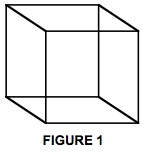
For example, the cube drawing in Figure 1 cannot be seen as both ‘cube-face-down’ and ‘cube-face-up’ at the same moment. It must be either the one or the other. Good enough. Look at it, and it is ‘cube-face-down’ (‘A’). Look at it again and it might have transformed itself into ‘cube-face-up’ (‘Not-A’). But what if it is not seen as a cube at all? What if it is seen as just a bunch of lines on a flat plane instead of a concocted three-dimensional object on a two-dimensional surface? As such, it is no more than the mere possibility of a cube. As a possible cube it contains, within itself, the potential for its realization either as ‘cube-face-down’ or ‘cube-face-up’. Considered as possibly either the one cube or the other, in its unrealized form we can say that it is both ‘cube-face-down’ and ‘cube-face-up’ (‘Both A and Not-A’).
But,… no,… that doesn’t tell the whole tale. Not really. In its unrealized state we can say that the concoction of lines in Figure 1 is either the one cube or the other one. It is possibly many other things besides: it can be a cake of ice, a glass case, or a wire contraption of some sort. In this case the ‘Not-A’ of ‘Both A and Not-A’ can imply an undefined number of possible things. What if someone sees the drawing as a ‘Cube’? Someone might see it at the same moment might as a box, and someone else as a wire construction, and so on. So what is it? It must be ‘Neither A (‘cube-face-down’) nor Not-A (‘cube-face-up’)’ but something else; in fact, a number of something elses. But,… this won’t quite do the trick either. In our considerations we are taking the lines in terms of incompatible existential forms: unrealized cube (‘Both A and Not-A), realized cube (‘One thing, or another, or another’), and the future possibility of undefined alternatives (‘Neither the one thing nor the other but some else’). If we remain true to logical principles, we shouldn’t mix things up in such a manner.
So, let’s say that the proper assertion regarding Figure 1 can be ‘All the above’, if we wish to disregard the incompatibility. And why not? If we are doing a number on traditional logical principles, why shouldn’t we go whole hog? We include all the assertions, ‘A’, ‘Not-A’, ‘Both A and Not-A’, and ‘Neither A nor Not-A’. Then, the more sober side of us abjures. We would prefer the comfortable confines of consistency. So with respect to the above assertions, including ‘All the above’, we proclaim ‘None of the above!’ And we end up with the Tetralemma coupled with its assertion and its negation, no more, no less. We took it all in our stride, as if it were as natural as could be.
In a remotely comparable fashion, we have observed, a subnuclear event of contemporary quantum theory cannot be both a particle and a wave; it must be either the one or the other. And yet, the quantum event can be both particle and wave, if we contemplate the two manifestations of its schizophrenic nature. It can be ‘particle’ as the ‘actualization’ of a ‘wave’ on Mondays, Wednesdays, and Fridays, and it can be ‘wave’ as an ‘unactualized particle’ on Tuesdays, Thursdays, Saturdays. Or it can be considered neither particle nor wave, but something else, perhaps ‘wavicle’, on Sundays. As both ‘particle’ and ‘wave’, we are considering the event in near-simultaneity, but not-quite-exactly at the same instant in time. As neither ‘particle’ nor ‘wave’, it is just that: neither the one nor the other, but something else, something that at some moment or other happened to push its way through the erstwhile Excluded-Middle that has transmuted into the Included-Middle.
Back to Nāgārjuna for a few moments.
Contradictions? No problem!
B. K. Matilal (1971: 162-65) shows how in what is called the Svatantrika strain of the Mādhyamika school of Buddhism, apparent contradictions lose their sting. On this interpretation, negation can be taken in two different ways. Allow me to continue with the ‘wave-particle’ pair of terms for illustration.
Take two sentences, ‘This unactualized particle is a wave function’, and ‘An actualized wave function is this particle’. If we deny the adjective of the first sentence, we have ‘This actualized particle is a wave function’. This won’t do. In effect we denied ‘unactualization’ of the particle. In a roundabout way this is a double negation. But the double negation did not yield negation of the predicate, ‘is this particle’. Actually, ‘this particle’ is not a ‘wave function’. ‘Particle’ and ‘wave function’, are complementary terms, not equivalent terms. As complementary terms, there can be a ‘wave function’ now and ‘this particle’ in the next moment, but the two cannot emerge to meet us in the same moment. Complementarity leaves the Principle of Non-Contradiction intact.
The adjective of the second sentence tells us what the ‘wave function’ is not. It is not ‘actualized’. There is no need of denying the adjective, for the adjective already says what the subject is not. That is, the predicate, as complement of the subject, is what the adjective of the subject is not. The predicate is an ‘actualized wave function’. In other words, if we assert ‘actualization’ of the ‘wave function’, we hold to the complementarity principle: ‘An actualized wave function is this particle’ implies that ‘An unactualized particle is a wave function’. However, it might be the case that ‘this particle’ is neither that particular ‘unactualized wave function’ nor is it not that particular ‘unactualized wave function’. Any ‘unactualized wave function’ is a ‘wave function’. That much is clear. But an ‘actualized wave function’ can take on many faces. It can be ‘this particle’ here, or it can be any one of a virtually unlimited number of other possible ‘particles’ somewhere else. So the two sentences, ‘This unactualized particle is a wave function’ and ‘An actualized wave function is this particle’, are asymmetrical. ‘This particle’ was an ‘unactualized wave function’ but an ‘unactualized wave function’ is not necessarily ‘this particle’. It could be ‘that particle’, or some ‘other particle’. This is because a particular ‘particle’ is one, while the ‘unactualized wave function’ entails many in terms of a range of possible ‘particles’. The Excluded-Middle Principle doesn’t hold with respect to the complementarity principle, since between one ‘wave function’ and a ‘particular particle’ there could have been many ‘alternate particles.
Now, all this might appear as so much word spinning. The Excluded-Middle (neither A nor Not-A) contends with the Bivalent Principle (either A or Not-A), but it virtually ignores the Non-Contradiction Principle (not both A and Not-A). In contrast, if A and Not-A are considered in simultaneity, then Non-Contradiction continues to exercise its force. A quite feasible way to abrogate both the Excluded-Middle and Non-Contradiction is Nāgārjuna’s Middle Way. In one fell swoop, it negates all four sentences of the Tetralemma. Following ‘A’, ‘Not-A’, ‘A and Not-A’, and ‘Neither A nor Not-A’, and in light of our tentative observations of Figure 1, Nāgārjuna, with a few strokes of the quill, writes ‘All of the above’, and then he caps it off with ‘None of the above’. Beautiful, and monstrous.
One might retort: ‘Monstrous, but hardly beautiful, for the only possible response is apathy or nihilism’. But not really. There’s actually nothing to be concerned over when confronting the Tetralemma. You say you don’t like ‘Both A and Not-A’? So, negate it. And you can plod along the narrow path of two-valued classical logical thinking. You like it? Then revel in it to your heart’s desire. ‘Neither A nor Not-A’ throws a bit of fear in you? Take it in your stride or simply forget it. By all means don’t fret over it. It could give you nightmares. You take a liking to it? Kick your heels up and sing praises to the free-wheeling play of the universe. We are free to accept the Principles of Non-Contradiction and Excluded-Middle, but we don’t necessarily have to if we don’t want to. That’s the beauty of it all (Nishitani 1990).
{pagebreak}
I do not mean what I just wrote in some frivolous way. Nor am I advocating irrationalism, and I am certainly not implying nihilism. The Mādhyamika is not really irrational, because ‘it is not irrational in that it nowhere contradicts the principle of Non-Contradiction’ (Staal 1975: 40). That is to say, it doesn’t contradict the Principle of Non-Contradiction in the event that you wish to stick to classical principles. It lets you do as you wish. Live and let live.
Actually, the logical liberty I am proposing is not as wild as it seems at the outset. Nor is it entirely unknown to Western thinking. Intuitionist mathematician L. E. J. Brouwer argued that when we are considering infinite sets—or anything else that is equally unsurveyable—it is not always the case that ‘Either A or Not-A’. There can be values other than merely the dichotomous pair. Something else can always emerge between the either and the or. With neither time nor space to go into detail, I might add that Ludwig Wittgenstein developed a controversial paradox regarding rule following along comparable lines (Baker and Hacker 1984, Shanker 1987). Putnam (1981) expounded at length on a natural language rendition of what is called the ‘Löwenheim-Skolem Paradox’ to yield comparable results. Then we have Kurt Göödel’s incompleteness theorems. Göödel demonstrated that a sufficiently rich formal systems is destined either to incompleteness— hence it must be opened and a new sentence added— or inconsistent. If it is incomplete, it must be opened for reception of some clarifying details. If it is inconsistent, it cannot pass the classical logical litmus test. So it must be amended or tossed in the circular file and replaced by something else (DeLong 1970, Goldstein 2005). If these apparently devastating consequences of tough-minded formal thought and reason apply, then what chance do the tender-minded disciplines have of getting things right once and for all time?
The moral to the story? Dilemmas of thought and reason there will always be; however, in the world of everyday life processes, the timeless iron-handed control of reason and thought wanes, for they have no direct bearing on concrete temporal process. So forget about quandaries. Keep things open by allowing for Included-Middles if you need to. Embrace the Principle of Non-Contradiction and at the same time embrace Contradiction when it becomes expedient to do so— and all other binary antagonisms for that matter. In other words, when things are a question of what can usually be considered C. S. Peirce’s bivalent category Secondness, Non-Contradiction can be our best friend. When Peirce’s unary, self-contained, self-sufficient, self-reflexive category Firstness is up for contemplation, Contradictions can exist as quite peaceful bedfellows, and our creative thoughts and we can be so much the better for it. When Peirce’s triadic, mediary category Thirdness and the necessity of new concepts, procedures, strategies, tactics, methods, and theories are up for alteration, something always stands a chance of emerging from the gap between erstwhile Excluded-Middles; consequently, what was once excluded can now be included. As the context goes, so also the affirmation or the negation of any of Nāgārjuna’s sentences.
In this light, those who follow the Mādhyamika rely on the Principle of Non-Contradiction whenever they attempt to refute their opponents. For, ‘the notion of refutation depends on the correct use of the particle “not” and makes no sense unless that principle is presupposed’ (Staal 1975: 42). The Mādhyamika method can be effective only insofar as the Contradictions they derived in their argument are considered intolerable and Non-Contradiction is deemed at least for the time and within that particular context valid. For, if the Mādhyamika can ‘harbor contradictions in their own position, they could not claim to have refuted their opponents on the ground that only they did the same’. Moreover, if the Principle of Non-Contradiction is not accepted as valid, then the Mādhymaka’s opponent’s views are ‘just as good as the negations of these views, and cannot therefore be shown to be false’ (Staal 1975: 42).
I cannot overemphasize the important point that Mādhyamika thought does not simply reject the tenets of classical Western logic. Mādhyamika scholars make best use of logic whenever they need to. For example, they use it to develop an argument between two opposite views, their’s and their opponent’s. If their opponent’s argument defends classical logic, then they use logic to trash logic. Yet they are also comfortable outside ordinary logical principles, for they are aware of logic’s limitations. Besides, if binary logic were all we had to work with, then forget about Peirce’s Firstness. Forget about creativity and novel concepts. And forget about the very idea of waves and particles too, for waves, as ‘possibility’ or ‘potentiality’ in the words of Werner Heisenberg, are a matter of Firstness. As such, they are absolutely necessary for the existence of our actualized world of things and their opposites as we know it. If we ignore Firstness, then forget about Thirdness as well. For anything and everything in the way of novel thought comes by way of emergence from the virtually infinite expanse of possibilities of Firstness.
However, I have certain truck with the Mādhyamika in regard to what might be construed as an esoteric posture. When a contradiction is dissolved by placing it in a new context, that new context invariably allows for a sense of something that is such as it is and it is not such as it is. It either is such as it is or it is not such as it is for ordinary folks. But the learned sages know better: they have been enlightened. For them, it is both such as it is and it is not such as it is and it neither is such as it is nor is it not such as it is. This move ignores the Principle of Identity. For, the assumption has it that nothing is as it is, for it is already becoming something other than what it was becoming. For example, it is often the case that what is today’s common sense and the intuitive view of popular culture was yesterday’s esotery, and occasionally what emerges from popular culture later by some quirk becomes profound philosophic, scientific or artistic insight.
After all, Picasso got his inspiration from African art. Schopenhauer’s philosophy and Bohr’s complementary principle owe a debt to Eastern philosophers. Wittgenstein’s ‘language games’ purportedly came to him when he was walking the streets near a soccer stadium during a match. Tolstoy was taken by folk culture. And Einstein was obsessed with what might appear to pedants and snobs as so many childish games. On the other side of the ledger, a few centuries were required for the Copernican-Galilean-Cartesian-Newtonian mechanical corpuscular-kinetic view, presupposing linear time and space, to become commonplace. By the beginning of the twentieth century, however, the citizens of the West had become so inculcated into that world that they could hardly perceive and conceive of their world as anything else. We are at present still struggling with the world of relativity and quantum theory. A few centuries down the line, and who knows how the world will have become according to commonplace assumptions held by ordinary folks.
This reminds one of physicist Arthur Eddington’s mentioning to an audience during the early days of relativity theory that there were only three people in the world who understood it. It was taken for granted that one of them was Einstein. The audience acknowledged that much. Then, Eddington jocularly began speculation as to who the third person might be. Considerations of relativity theory have changed drastically since that time. Now, the basics of relativity and quantum theory are taught in high school physics classes. It is remotely conceivable that at some time in the future, relativity and quantum theory may be as commonsensical as Newtonian mechanics and Euclidean geometry are today.
An other way?
If as H. H. Pattee suggests, at the very heart of life itself lies paradox, with renewed energy we can forget about quandaries, keep things open by allowing for Included-Middles if we need to, and embrace the Principle of Non-Contradiction. Perhaps in some form or another paradox at the quantum level extends upward to all levels. If this is so, then to expect the mind or consciousness to free itself of paradox is out of the question. It is more problematic to assume that enlightenment pays the paradox no mind and enters into some ethereal zone free of conflicts.
I would rather take it that, like Wittgenstein once said of logical conflicts that drive philosophers to fits, one should let go of the tension the paradox engendered, and show the fly out of the fly bottle. The fly enters the bottle, drawn by a sweet odor or some other attraction. Once inside, it rebounds at random against the inner boundaries of the container within which it is trapped. It does not fly toward the neck of the bottle, for in that direction its prison becomes more confining. So it remains within that part of the bottle of greatest circumference. If we show the fly its way out of the bottle, it is not free to roam at will. Rather, it remains oblivious of the fact that, although its world is now considerably larger, it is still caught within an existential prison. But not to worry. The parameters of this new prison are large enough for comfort. So our fly, now liberated from its erstwhile prison, is a happy fly. As far as it is concerned, its world is unlimited, infinite. It can fly in any direction it pleases, forever.
This seems to be the genuine Buddhist way, especially as incorporated within Zen Koans. The master asks the the apprentice ‘What is the sound of one hand clapping?’— from among a host of other Koans. How can she respond? She is placed in a bind. If she decides she can’t respond she fails the test, because she has exercised a mind search for a response and came up empty handed. That is the problem: she tried to solve the problem by an act of mind. If she decides the answer is ‘Silence’, she also fails. She tried, and came up with an answer, by just another mind act. So she tries gravely to try no more, and fails. For to try not to try is still the mind trying to mind the body. She decides to refrain from choosing an answer altogether, and fails. Her choice was mind motivated. What is an apprentice to do? At some point she rather mindlessly lets go of the paradox, and then she feels and senses the world anew.
This last move is not a mind act, not the product of a logico-rational process, not a selection or a choice, but a matter of the body simply doing what it does: it bodyminds, so to speak. As such,
there is no conflict between body and nonbody, living and nonliving, animate and inanimate. Everything is in a flowing, liquid embrace.
{pagebreak}
Perhaps to test the apprentice’s capacity to feel and sense bodymindingly, the Master holds a stick over her head and tells her: ‘If you say anything I’ll strike you on the head; if you don’t say anything I’ll strike you on the head’. A rather untenable situation, for sure. Now our apprentice can’t even remain silent with the assumption that she has chosen correctly. What is the young lady to do at this juncture? Meekly turn her other cheek? Or turn the tables completely: grab the stick from the Master——assuming she is nimble and quick enough, which she most likely is not——and hit him with it. But how dare she fly in the face of a tradition that commands complete, unquestioning obedience, respect, and veneration of the Master? She dares do what she did, because she broke the rules. By so doing, she might be able to think she won in her contest with the Master. As a consequence, she failed the test on two counts. First, her decision to grab the stick from the Master’s hand and hit him with it was likely yet another mind act. Second, she ‘won’, which is to assume there can be winners and losers. She was wrong, however, for there are neither winners nor are there losers; there is only process.
Granted, it might appear that during apprenticeship, superordination-subordination relations exist between Master and apprentice. That, however, is not a matter of social hierarchization in the ordinary Western sense. Rather, it is more akin to a complementary relationship between two individuals. In a complementary relationship, Master and apprentice merge into one. They are two, but they are one. They are one, yet they are two. At the same time they are neither two nor are they one. The apprentice pays respects to the Master in the most stringent way: never speaking until first having been addressed, never initiating interactive exchange. The Master maintains profound respect toward the apprentice: teaching by example, correcting by what might appear as verbal and physical abuse but actually it’s carried out in the manner of a loving parent. Each knows her/his place in the hierarchy, yet there is no Western dominating/dominated, superordinate/subordinate relationship, but rather, the roles are complementary in the sense that there is always a little of an apprentice in the Master and a little of a Master in the apprentice.
Confusing all this, for sure. Yet, it is the way. Unfortunately, to articulate complementarity within the context of its bodymind functioning with respect to human interdependent, interrelated, interaction? is inevitably to hierarchize it. To hierarchize it inevitably creates in the Western mind binary either/or rather than complementary images and concepts. Complementarity cannot be effectively articulated and understood if one doesn’t already sense it. It is living process. It is feeling process. It is a matter of bodymind’s natural doings. It is bodymind bodyminding bodymindingly. Still confusing. At best, I would hope at least a vague sense of complementarity may be forthcoming by the end of this essay. For now, best I continue my story about complementary interdependency, interrelatedness, and interaction instead of wasting energy trying to say it directly.
So, if our apprentice chooses to teach the Master a lesson, is she in the final analysis right or wrong? She is right, because she found her way out of the confines of the untenable situation. However, assuming she stepped out of the paradoxical conflict by an act of mind, she is wrong. So in a manner of speaking she is both right and wrong and she is neither right nor wrong. And the exasperation persists. Actually Hamlet was caught up in this sort of quandary. He speculated that nothing is either right or wrong, or more faithful to Shakespeare’s work, nothing is either good or bad, but thinking makes it so. In a way, therein we have the nonanswer answer to our problem. Logic and reason and thinking and then words, words, words, can convince us that we are right with the world; yet our enemies, by logic and reason and thinking and then words, words, words, can convince themselves that we have deceived ourselves and that they are right.
This has been another of the cantankerous dilemmas of Western societies. The grand Enlightenment project was supposed to put the West on the desired track. The track would end with social organization according to preconceived models, unlimited scientific and technological progress, the end of inequities between classes, and emancipation for all peoples. Economies would expand indefinitely, everybody would enjoy the good life, and scarcity and need would become virtually nonexistent.
However, things didn’t quite go as planned. Problems arose, and culminated in our times. We have had the most devastating wars ever, ‘ethnic cleansing’——if I may use that absurd phrase that in our times politically corrects more abusive epithets——became common practice in some cultures, leading to the mass extermination. And, of course, we now have terrorism on a massive scale to contend with. There has been endemic political corruption, ecological destruction, personal and social alienation leading to increasing suicide rates, alcohol and drug abuse, indices of mental health problems, and increasing gaps between rich nations and poor, and upper classes and lower classes within nations. It all began in earnest with a utopian project that was supposed to be absolutely good for humankind. But it backfired. In many respects it was not good at all; it turned out bad.
But . . . wait a minute. Is it not true that longevity has increased and infant mortality is lower? Have many diseases not been virtually eradicated? Do not more people enjoy labor saving devises thanks to technological development than ever?
Well, yes. And also no. No, because very recently, conditions have actually become worse in some cultures, and we have hitherto unknown epidemics such as AIDS, that is actually lowering the life expectancy of many people in Africa. Obesity, especially in the U.S., has created heart problems and an epidemic of diabetes that threatens to lower life expectancy. Increased ultraviolet radiation brings on increased risks of skin cancer. I trust I need not belabor the point that the Enlightenment project was both good and bad, dependent on the mind of the beholder. And it was neither wholly good nor bad, from a third view. From this third view, one might assume that if it is neither wholly good nor bad, then there is room for improvement, for completion of the project by keeping what is good and chipping away at that which is bad in order to make it good——e.g. Jurgen Habermas’s grand project. Still, there is good and bad in virtually everything, according to the perspective.
Take a rather mundane example. Is Johnny good or bad? Many people who know him say he’s intolerable, a selfish, cruel, lying, stealing, cheating, and an inordinately self-indulgent brat. A few will say at heart he is an O.K. kid; he just has a mischievous streak in him. His father has meted out punishment so many times without success that he has given up on his upstart son. His mother, of course, thinks he’s a little angel, if everybody would give him a chance. In the final analysis, then, is Johnny good or bad? He is good, and he is bad, and he is both good and bad, and he is neither good nor bad, strictly speaking. His goodness or badness is undecidable, for the two terms are not really opposites: they are complementarities. In Johnny, in the good there is a little bad, and in the bad there is a little good. He is good and he is bad, yet he is neither good nor bad, but possibly something else, something different. Perhaps he is just an ugly kid and for that reason has certain feelings of rejection and his bad streak is only a manifestation of his resentment. So he is just ugly. Johnny the good, the bad, and the ugly. Now we have three terms to contend with. Perhaps he is big for his age and bully tactics come easily. Perhaps he is shy around girls and makes up for it with aggressiveness toward his male playmates. So we have Johnny the big, the bully, and the bashful. Perhaps his father’s beatings have created a child driven by violence. Now it’s Johnny the victim and the victimizer. The self-contradictory possibilities are virtually unlimited. Johnny’s goodness-badness complementarity is not properly qualifiable outside the consideration of virtually every aspect of his personal history and the myriad array of contexts that made it up.
If we think understanding Johnny is difficult, let’s go find a culture with which we are unfamiliar and try to comprehend it. Anthropological studies point toward complementary practices between cultures the world over. Some cultures have no obsession for tridimensionalizing the world, for seeing virtually everything in terms of depth, such as does the West by way of Euclidean straight lines that converge, like the two lines of the railroad track toward an infinitely distant point. Citizens of such cultures make little attempt to depict three dimensionality on a two-dimensional plane and call it art. Their painting is more of the cubist sort. In fact, Pablo Picasso’s influence from African art led to his development of cubism, a form of painting that spreads the front, the sides, and the back of a three-dimensional object on a two-dimensional plane. Our converging three-dimensional Euclidean picture of the world is complementary with alternatives found in other cultures. It is not a matter of our picture being right and others’ pictures being wrong. No picture is necessarily either right or wrong, but thinking can often make it so. (Recall the cube in Figure 1, that is nothing more than a set of lines on a two-dimensional place, but it is rather automatically tridimensionalized by Western onlookers, inculcated as we are by Euclidean principles.) Once again, the stories are virtually countless.
{pagebreak}
Between the either and the or
However, please allow me one more example for the purpose of illustration. Many non-Western cultures make no categorical distinction between life and death, but rather, see them as two complementary forms making up one form. Instead of life/death, we might say there is ‘Leath’, or perhaps ‘Dife’. ‘Leath’ is a hybrid form of the life/death composite, and ‘dife’ is a hybrid form of the death/life composite.
Now I realize this probably grates on the eyes and ears. But in order to illustrate life with a tinge of death and vice versa within the English language that is ill equipped for complementary expression, perhaps that’s the best way to do it. At the deepermost level, life and death are like Yin and Yang, or ‘Ying’ and ‘Yan’, if you will. They are separate, and yet they are inseparable, and they are neither separate nor are they separable. In their swirling, undulating embrace, they are two and they are one.
Yin, dark, deep, mysterious Yin. Once it was in complementation with Yang to compose the whole form that mediated between the two, sympathetic, undulating, resonant, movement emerged. Unfortunately, the West pushed Yin aside to prioritize Yang. Proud analytical Yang, the enlightened one. Its uncountable Boolean bits pile up to form a heap so large that no matter how many bits are removed, it’s still a heap many of whose parts are known digitally but whose whole is unfathomable.
So, we have ‘Leath’, or life that has not really taken its leave of death in the dualist sense but life as another form of existence that usually goes by the name, death. Or we have ‘Dife’, death that is tinged with life principles, since it contains some aspects of life, just as life contains some aspects of death. There is no absolute distinction between life and death. Rather, bodymind becoming is either ‘Leath’ or ‘Dife’, according to the vantage point. It can also be considered both ‘Leath’ and ‘Dife’ as well. Or it can be considered neither ‘Leath’ nor ‘Dife’, but something else, if we wish. All things considered, bodymind becoming is all of the above, and it is none of the above. The West has life that terminates at time tn and death that commences at that same time. Other cultures have ‘Leath’, or they have ‘Dife’, two words for the same process. The one word qualifies bodymind becoming during thisworldly time and the other word qualifies bodymind becoming during otherworldly time, both times merging into one another to create a whole cosmic process. These cultures have no all-or-nothing split between life and death. In contrast, what for us is death and a time of mourning could be for them a time of jubilation, and what for us is birth and the beginning of a new life and cause for celebration is for them also jubilation over a newly emerging process of becoming.
The West took its leave of most other cultures when Cartesian-Newtonian linear, corpuscular-kinetic, classical mechanics took a leap of faith in logic, reason, objectivity, and analysis. On so doing, the West went whole-hog Yang. Yin, virtually unfathomable Yin, was consequently pushed under the carpet in hopes she would soon be forgotten. There is no complementarity here in Niels Bohr’s conception in this classical picture. When complementarity is genuinely in play, just as our photon shows no preference for either its wave nature or its particle nature, so also neither should we play favorites. And just as Yang holds no power over Yin, so the interdependent, interrelative, interactive, incongruous complementarity between them holds. Incongruous complementarity forces us to the conclusion that nature is neither independent of us nor we of her. Everything is interconnected with everything else.
Now what do I mean by that? That life is connected to death. That in a certain way of putting it, to say life is also to say death. You simply cannot separate the two. Yet they are separate. Life is death (‘Leath’) and death is life (‘Dife’), and at the same time neither is it the case that the one is the other nor that the one is not the other——they are ‘hybridized’. There is neither absolute life nor absolute death, in the same way that there is neither absolute goodness nor absolute badness. If absolute distinctions are made between life and death and good and bad, the distinctions are in the head; they are mind acts. If there are no absolute distinctions but only matters of difference, then the differences are not in the mind but in the heart and the gut, in feelings and sentiments and emotions and intuition. All this has to do with bodymind rather than merely mind. It is not a matter of either body or mind, for they are interdependent, interrelative, interactive, and incongruously complementary: they are bodymind. In this respect, somewhat like Yin and Yang, there is no body without a bit of mind and mind can never divorce itself entirely from body. In concert they make up bodymind, in its process of bodyminding bodymindingly.
If mind still insists on having its way, then dire consequences might be in store——and at times they have been in the West. If the citizens of a given society were suddenly to behave like mindless bodies, then personal desires, wishes, and whims would predominate, and anarchy would raise its ugly head. Some mind and some body is good, but too much of either can be bad. As we saw above in passing, many things can be qualified in this manner. Fire is good for cooking but bad when devastating a national park. Water is necessary to sustain life; it also causes floods. Bacteria are good for fermentation and decomposition; they also bring diseases. Cars and guns provide transportation of sport and hunting; they can also kill. The mouth allows us to communicate; it can also get us in trouble when a foot is firmly placed in it. If mind and mind alone, satisfied with nothing less than absolutes regarding eithers and ors, decided when cars could be used with absolute safety and guns could be carried without danger to anybody, then we would undoubtedly remain carless and gunless. If body were completely in control, havoc might threaten to reap a rich harvest. There must be a happy balance between body and mind such that bodymind is the yield.
In fact, bodymind, rather than body and mind in presumed separation, is the only way to establish and keep the balance. However, giving lip service to bodymind’s health is easy; actually practicing it is difficult. Mind might take its leave of bodymind and try to keep body on the straight and narrow, but temptations keep popping up, and it succumbs, with mind trailing along behind. The difficulty is getting bodymind in tune with itself to the extent that no mind is paid to the temptations, and bodily desires are not the controlling factor.
Mind can rationalize bad into good ad infinitum, but under ordinary circumstances body can’t simply ‘Just say no’ to drugs and alcohol. The alcoholic knows full well that after each binge the mind can with authority declare ‘Enough!’, but the body wins out in the end. Or the body is aching and the mind says ‘Just a little hair of the dog that bit me isn’t going to hurt’, and it’s on the merry-go-round one more time. Mind can convince itself it’s doing the right thing; then it discovers that something has gone terribly wrong. Body does what it does without input from mind, and gets itself in a heap of trouble. In contrast, when bodymind maintains a healthy balance, the bad side of things pretty much stays in the dark, and the good side emerges. But first, bodymind must find the most genuine balance.
Balance. I apparently use the term with the greatest of ease. But the Eastern tradition requires subtle years of apprenticeship and atunement to bodymind before it can emerge into consciousness as if spontaneously, and the Western tradition requires painful years of learning and analyzing and focused attention to what is learned and analyzed before bodymind can purportedly become the product of consciousness. Two roads to the same destination, one through reason and logic and the other through religion and faith? Perhaps. Perhaps mind, master of serene reason and logic, and body, storehouse of intuition, faith and fervor, should not, cannot, proceed as if they were proud, self-contained, autonomous fragments rebounding within the whole. Perhaps mind and body have been, are, and will have been, bodymind all along, whether we knew it or not and whether we liked it or not. Perhaps.
Notes:
1. I have used the terms ‘interdependency’, ‘interrelatedness’, and ‘interactivity’ extensively in past studies (for example merrell 2000a, 2002, 2003, 2005, 2007). They have been inspired by Charles S. Peirce’s concept of the sign and his categories of thought, of signs, and of the world’s phenomena (Firstness, Secondness and Thirdness), by pragmatic philosophy in general, by Buddhist philosophy, and by recent developments in quantum physics and the science of complexity—insofar as have been able to grasp them.
2. From a variety of sources we have the suggestion that the world is not as obedient to logical principles as has been traditionally assumed (for example Goswami 1993, Lupasco 1947, Melhuish 1967, Merrell 1991, Rescher and Brandom 1979, Schlegel 1967, Smith 1995).
3. For an early study see LeShan 1974; for a survey of this topic from diverse points of view, including pro- and anti-science, and pro- and anti-New Age and paranormal science, see Cartwright 1999, Cole 1984, Davis 1997, Gregory 1988, Hagen 1995, Harding 1998, Horgan 1996, Pickering 1995, Romanyshyn 1989.
4. I will term Buddhism a ‘doctrine’ rather than a ‘religion’ or ‘philosophy’, since it is neither a ‘religion’ nor a ‘philosophy’ in the Western sense, but rather, a way of co-participating with the world, of interdependently, interrelatedly, interacting with the world.
5. The notion of something undergoing alteration from one color to another, or from some sensation received from any of the sensory organ to another, bears on the problem of induction, especially in light of the assumptions in this essay of Nelson Goodman’s (1965) ‘New Riddle of Induction’ that has been the focus of heated debates and has driven many a philosopher up the wall (see Stalker 1994).
6. For a discussion of the nature of the terms focal and subsidiary, see Polanyi (1958, 1966), and for application of the terms to communication along the lines of Peirce’s concept of the sign, see merrell (1995a, 2000).
7. Briefly, Firstness is unary: what is what it is, as a self-contained whole; Secondness is what it is, in terms of its interrelations with something else; Thirdness is what it is, insofar as it mediatingly brings Firstness and Secondness into interrelationship with each other in the same way that it brings itself into mediated interrelationships with them (for more on Peirce’s categories of thought, see Peirce 1931-35, passim; for a discussion of the categories, Almeder 1980, Hookway 1985, Merrell 1995b, 1997.
8. Along these lines, from within Western thought, I would suggest a reading of Barnes and Bloor (1992), Bloor (1983), Feyerabend (1987, 1999), Geertz (1989), and Margolis (1991).
9. With respect to Western culture in general, this theme is argued forthrightly in Capek (1961), Heelan (1983), Shlain (1991), and others on art and science, and Barfield (1965), and Berman (1981).
10. Also, Varela (1979); regarding paradox at the quantum level, Bohr (1961), Wheeler (1994), Melhuish (1967).
11. In ‘Leath-Dife’ I have taken to the liberty of extending Goodman’s (1965) ‘New Riddle of Induction’ that has ‘Emeralds are green’ for us but they are ‘Grue’ for some strangers from a strange land, which is to say that from our perspective they think ‘Emeralds are green’ up to a certain time and thereafter they think ‘Emeralds are blue’ (for further, Merrell 1997).
References
Almeder, Robert (1980). The Philosophy of Charles S. Peirce: A Critical Introduction. Totowa: Rowman and Littlefield.
Baker, G. P. and P. M. S. Hacker (1984). Scepticism, Rules and Language. Oxford: Basil Blackwell.
Barfield, Owen (1965). Saving the Appearances. New York: Harcourt, Brace, and World.
Barnes, Barry and David Bloor (1982). ‘Relativism, Rationalism and the Sociology of Knowledge’. In Rationality and Relativism, eds. M. Hollis and S. Lukes. Cambridge: MIT.
Berman, Morris (1981). The Reenchantment of the World. Ithaca: Cornell University Press.
Bloor, David (1983). Wittgenstein: A Social Theory of Knowledge. London: Macmillan.
Bohr, Niels (1961). Atomic Theory and the Description of Nature. Cambridge: Cambridge University Press.
Capek, Milic (1961). The Philosophical Impact of Contemporary Physics. New York: Van Nostrand.
Cartwright, Nancy (1999). The Dappled World: A Study of the Boundaries of Science. Cambridge: Cambridge University Press.
Chomsky, Noam (1988). The Culture of Terrorism. Boston: South End Press.
Chomsky, Noam (2002). Media Control: The Spectacula Achievements of Propaganda. New York: Seven Stories Press.
Chomsky, Noam (2006). Failed States: The Abuse os Power and the Assault on Democracy. New York: Metropolitan Books.
Cole, K. C. (1984). Sympathetic Vibrations: Reflections on Physics as a Way of Life. New York: William Morrow.
Conze, Edward (1970). Buddhist Thought in India. Ann Arbor: University of Michigan Press.
Davis, Joel (1997). Alternate Realities: How Science Shapes our Vision of the World. New York: Plenum.
DeLong, Howard (1970). A Profile of Mathematical Logic. New York: Addison-Wesley.
Feyerabend, Paul K. (1987). Farewell to Reason. London: Verso.
Feyerabend, Paul K. (1999). Conquest of Abundance. Chicago: University of Chicago Press.
Geertz, Clifford (1989). ‘Anti Anti-Relativism’. In Relativism: Interpretation and Confrontation, ed. M. Krausz. Notre Dame: University of Notre Dame Press.
Goldstein, Rebecca (2005). Incompleteness: The Proof and Paradox of Kurt Gödel. New York: W. W. Norton.
Goodman, Nelson (1965). Fact, Fiction and Forecast, 2nd ed. Indianapolis: Bobbs-Merrill.
Goswami, Amit (1993). The Self-Aware Universe. New York: J. P. Tarcher.
Gregory, Bruce (1988). Inventing Reality: Physics as Language. New York: John Wiley.
Hagen, Steve (1995). How the World Can Be the Way It Is. Wheaton, IL: Theosophical Publishing House.
Harding, Sandra G. (1998). Is Science Multicultural?: Postcolonialisms, Feminisms, and Epistemologies. Bloomington: Indiana University Press.
Heelan, Patrick (1970). ‘Complementarity, Context-Dependence, and Quantum Logic.’ Foundations of Physics 1 (2), 95-100.
Heelan, Patrick (1971). ‘Logic of Framework Transpositions’. International Philosophical Quarterly 11, 313-34.
Heelan, Patrick (1983). Space-Perception and the Philosophy of Science. Berkeley: University of California Press.
Hookway, Christopher (1985). Peirce. London: Routledge and Kegan Paul.
Horgan, John (1996). The End of Science. New York: Addison-Wesley.
Lakoff, George (1987). Women, Fire, and Dangerous Things: What Categories Reveal About the Mind. Chicago: University of Chicago Press.
Lakoff, George (2004). Don’t Think of an Elephant! White River Junction, VT: Chelsea Green Publishers.
Lakoff, George and Mark Johnson (1980). Metaphors We Live By. Chicago: University of Chicago Press.
LeShan, Lawrence (1974). The Medium, the Mystic, and the Physicist. New York: Viking.
Lupasco, Stéphane (1947). Logique et contradiction. Paris: Presses Universitaires de France.
Mansfield, Victor (1995). Synchronicity, Science, and Soul-Making. LaSalle, IL: Open Court.
Margolis, Joseph )1991). The Truth about Relativism. London: Basil Blackwell.
Matilal, B. K. (1971). Epistemology, Logic, and Grammar in Indian Philosophical Analysis. The Hague: Mouton.
Melhuish, George (1967). The Paradoxical Nature of Reality. Bristol: St. Vincent’s Press.
merrell, floyd (1991). Signs becoming Signs: Our Perfusive, Pervasive Universe. Bloomington: Indiana University Press.
merrell, floyd (1995a). Semiosis in the Postmodern Age. West Lafayette: Purdue University Press.
merrell, floyd (1995b). Peirce’s Semiotics Now: A Primer. Toronto: Canadian Scholars’ Press.
merrell, floyd (1997). Peirce, Signs, and Meaning. Toronto: University of Toronto Press.
merrell, floyd (2000a). Signs, Science, Self-Subsuming Art(ifacts). Dresden: University of Dresden Press.
merrell, floyd (2000b). Signs for Everybody: Or, Chaos, Quandaries, and Communication. Ottawa: Legas.
merrell, floyd (2002). Learning Living, Living Learning: Signs, between East and West. Ottawa: Legas.
merrell, floyd (2003). Sensing Corporeally: Toward a Posthuman Understanding. Toronto: University of Toronto Press.
merrell, floyd (2005). Capoeira and Candomblé: Conformity and Resistance through Afro-Brazilian Experience. Princeton: Markus Wiener.
merrell, floyd (2007). Processing Cultural Meaning. Ottawa: Legas.
Murti, T. R. V. (1955). The Central Philosophy of Buddhism: A Study of the Madhyamika System. London:
Nagel, Ernst, and James R. Newman (1964). Gödel’s Proof. New York: New York University Press.
Nakamura, H. (1973). ‘Faith and Reason in Early Buddhism and Christianity’. Journal of Ecumenical Studies 1, 30-50.
Needham, Joseph (1954). Science and Civilization in China. Cambridge: Cambridge University Press.
Nishitani, Keiji (1990). The Self-Overcoming of Nihilism, trans. G. Parkes. Albany: State University of New York Press.
Pattee, Howard H. (1969). ‘How Does a Molecule Become a Message?’ Developmental Biology, supplement 3, 227-33.
Pattee, Howard H. (1972). ‘Laws and Constraints, Symbols and Languages’. In Towards a Theoretical Biology, ed. C. H. Waddington. Edinburgh: University of Edinburgh Press.
Pattee, Howard H. (1979). ‘Robert Rosen, Howard Hunt Pattee, and Raymond L. Somorja: A Symposium in Theoretical Biology’. In A Question of Physics: Conversations in Physics and Biology, eds. P. Buckley and F. D. Peat. Toronto: University of Toronto Press.
Pattee, Howard H. (1986). ‘Universal Principles of Measurement and Language Functions in Evolving Systems’. In Complexity, Language, and Life: Mathematical Approaches, eds. J. L. Casti and A. Karlqvist. New York: Springer-Verlag.
Peirce, Charles S. (1931-35). Collected Papers of Charles Sanders Peirce, eds. C. Hartshorne and P. Weiss, vols. 1-6. Cambridge: Harvard University Press.
Phillips, Kevin (2006). American Theocracy. London: Penguin.
Pickering, Andrew (1995). The Mangle of Practice: Time, Agency, and Science. Chicago: University of Chicago Press.
Polanyi, Michael (1958). Personal Knowledge. Chicago: University of Chicago Press.
Polanyi, Michael (1966). The Tacit Dimension. New York: Doubleday.
Putnam, Hilary (1969). ‘Is Logic Empirical?’ In Boston Studies in the Philosophy of Science: Proceedings of the Boston Colloquium for Philosophy of Science, 1966/1968, eds. R. S. Cohen & M. W. Wartofsky. Dordrecht: D. Reidel.
Putnam, Hilary (1971). ‘How to Think Quantum Logically’. In Logic and Probability in Quantum Mechanics, ed. P. Suppes. Dordrecht: D. Reidel.
Putnam, Hilary (1981). Reason, Truth and History. Cambridge: Cambridge University Press.
Putnam, Hilary (1983). ‘Vagueness and Alternative Logic’. Erkenntnis 19, 297-314.
Quine, Williard van Orman (1953). From a Logical Point of View. New York: Harper and Row.
Quine, Willard van Orman (1969). Ontological Relativity and Other Essays. New York: Columbia University Press.
Rescher, Nicholas and Robert Brandom (1979). The Logic of Inconsistency: A Study of the Non-Standard Possible-World Semantics and Ontology. Totowa, NJ: Rowman and Littlefield.
Robinson, R. H. (1967). Early Madhyamika in India and China. Madison: University of Wisconsin Press.
Romanyshyn, Robert D. (1989). Technology as Symptom and Dream. New York: Routledge.
Schlegel, Richard (1967). Completeness in Science. New York: Appleton-Century-Croft.
Schurmann, F. (1968). Ideology and Organization in Communist China. Berkeley: University of California Press.
Shanker, S. G. (1987). Wittgenstein and the Turning-Point in the Philosophy of Mathematics. Albany: State University of New York Press.
Shlain, Leonard (1991). Art and Physics: Parallel Visions in Space, Time, and Light. New York: William Morrow.
Smith, Wolfgang (1995). The Quantum Enigma: Finding the Hidden Key. Peru, IL: Sherwood Sugden.
Spencer-Brown, George (1979). Laws of Form. New York: E. P. Dutton.
Staal, Frits (1975). Exploring Mysticism: A Methodological Essay. Berkeley: University of California Press.
Stalker, Douglas (ed.) (1994). Grue! Chicago: Open Court.
Varela, Francisco (1984). ‘The Creative Circle: Sketches on the Natural History of Circularity’. In The Invented Reality, ed. P. Watzlawick. New York: W. W. Norton.
Wheeler, John Archibald (1994). At Home in the Universe. New York: American Institute of Physics.
Wilber, Ken (1983). Up from Eden: A Transpersonal View of Human Evolution. New York: Random House.
Wilber, Ken (ed.) (1982). The Holographic Paradigm and Other Paradoxes. Boulder: Shambhala.
]]>